How Is Nylon Made? The Material That Quietly Changed Human History
What do a toothbrush bristle, a military parachute, an airbag, and a pair of stockings that caused riots in 40 American cities have in common? One synthetic polymer — invented in a laboratory in 1935. And the journey from two simple chemicals to this material changed fashion, warfare, and manufacturing forever.
This is the complete story of nylon—from the chemistry that created it to the riots it caused, the war it helped fight, and the environmental problem it now creates.
The complete story:
The invention: Wallace Carothers and the condensation breakthrough: In 1927, DuPont hired Wallace Carothers away from Harvard to pursue pure chemistry with no defined goal. His mission: discover if you could build useful materials by linking small molecules into enormously long chains. On February 28, 1935, a member of his team produced the first batch of what would become nylon. Carothers’ key insight was deceptively simple — the condensation reaction that forms nylon also produces water as a byproduct, and that water was interfering, stopping the chains from growing. When he continuously removed the water as it formed, the chains grew long, strong, and elastic. A small change in the reactor that changed the world.
Nylon Day and the riots: DuPont introduced nylon at the 1939 New York World’s Fair, promising a material stronger than steel and more delicate than a spider’s web. On May 16, 1940 — officially Nylon Day — four million pairs of nylon stockings sold out across America in two days. Then the war took everything back. On February 11, 1942, the War Production Board commandeered every pound of nylon for parachutes, tire cords, glider ropes, and mosquito netting. Women who had paid $1.25 a pair watched black-market prices hit $10. When Japan surrendered in August 1945, DuPont announced the return of civilian nylon — and the nation went wild. In Pittsburgh, 40,000 people queued for 13,000 pairs. In San Francisco, 10,000 shoppers broke a store window, and the sale was canceled. In New York, 30,000 women lined up. History called it the Nylon Riots.
The chemistry: Nylon 6,6 explained simply: Nylon 6,6 is made from exactly two chemicals — adipic acid and hexamethylenediamine. The 6,6 is not a strength rating. It is a carbon count: each molecule contains exactly six carbon atoms. When they react together, they form an amide bond and release a water molecule — like two puzzle pieces clicking together and releasing a drop of water as they join. The repeating unit is [–NH–(CH₂)₆–NH–CO–(CH₂)₄–CO–]. What results is a long polymer chain — think of it like a very long train, where each carriage is a molecule. The length of those chains determines the material’s strength. The reaction happens at around 260 degrees Celsius — hotter than a domestic oven at maximum. What forms is neither quite a liquid nor quite a solid: a viscous polymer melt that flows like very hot honey.
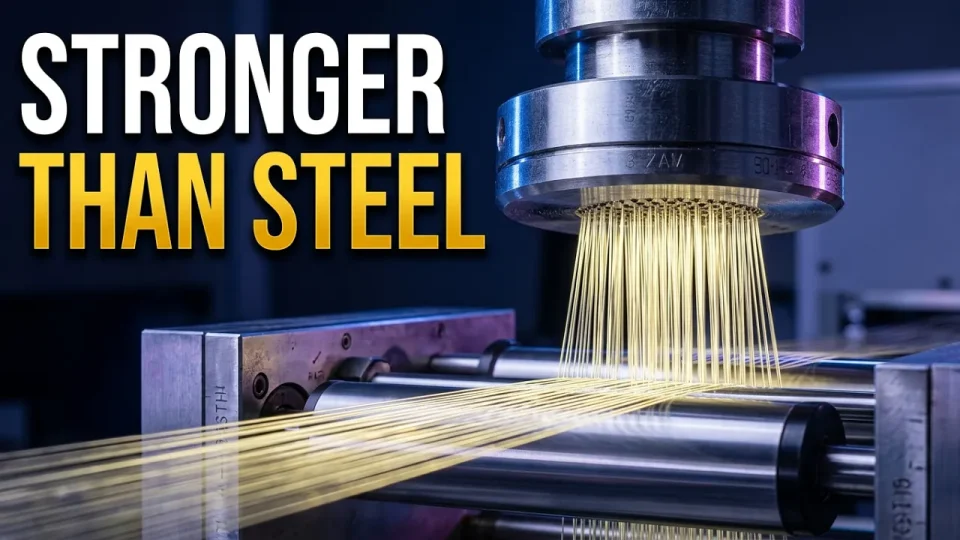
The factory: spinneret, drawing and winding: The molten nylon is pumped to a spinneret — a precision-machined metal plate drilled with hundreds of microscopic holes. Think of it as an industrial shower head for polymer. The moment the melt exits each hole it begins to solidify into a filament. Hundreds of filaments emerge simultaneously, each thinner than a human hair. But at this stage they are still relatively weak. Drawing stretches them to three to five times their original length — like pulling cold toffee — aligning the polymer chains into crystalline regions that make the fiber dramatically stronger. The drawn fiber is then wound at over 3,000 meters per minute onto bobbins ready for textile manufacturing.
Why nylon is strong: molecular structure: Nylon’s strength comes from two sources working together. Amide bonds along each polymer chain are intrinsically strong. Between neighboring chains, hundreds of hydrogen bonds act like tiny magnets running the length of every adjacent pair of chains. No single hydrogen bond is powerful. Together, they create the extraordinary collective strength that makes nylon suitable for airbags, surgical sutures, ropes, fishing lines, tire cords, and industrial gears.
Nylon vs natural fibers: the trade-offs: Cotton is breathable and biodegradable but weakens when wet. Silk is lustrous but expensive and delicate. Nylon is stronger than both, dries faster, resists abrasion, and costs a fraction of silk, but it is not breathable, not biodegradable, and is derived from fossil fuel feedstocks. Every material is a set of trade-offs.
The environmental problem: Nylon’s fossil fuel origin is one challenge. Another is microfibers — tiny synthetic particles released from nylon textiles during washing that pass through wastewater treatment and enter the ocean. Globally, only around 18 percent of nylon is recycled, compared to 31 percent for polyethylene. In 2024, post-consumer nylon waste exceeded 2.7 million metric tonnes.
The future: Bio-based nylon, made from castor oil, corn, or other plant feedstocks, is growing at approximately 20 percent per year. Major brands including Adidas, Prada, and Stella McCartney are sourcing recycled nylon from fishing nets and industrial waste. The global nylon market was worth approximately $36 billion in 2025 and is projected to reach $55 billion by 2032. The material is the same. The source is changing.
