How Is Optical Fiber Made? The Glass Thinner Than a Human Hair That Connects the World
How can a strand of glass thinner than a human hair carry the information connecting the entire world? Right now, somewhere in a factory, a glass rod the size of your arm is being heated to over 2,000 degrees Celsius and pulled into a thread that almost disappears before your eyes. This is how optical fiber is made. More than 5 billion kilometers of optical fiber are deployed worldwide. Nearly 99 percent of all international internet traffic crosses the oceans not through satellites but through glass threads lying on the ocean floor. Every video call, stream, financial transaction, and AI request travels at the speed of light through glass thinner than a human hair.
The complete story of how it’s made:
The impossible scale: fiber vs hair: Standard optical fiber has an outer diameter of 125 microns — thinner than a human hair. The core that carries light in a single-mode fiber is just 8 to 9 microns across. Yet this glass thread carries terabits of data per second over hundreds of kilometers without regeneration. The physics that makes this possible, total internal reflection, was engineered into the glass during manufacturing, layer by microscopic layer.
Why ordinary glass won’t work: ultra-purity. Ordinary window glass would stop light within meters. Optical fiber requires glass so pure it contains less than one part per billion of certain impurities. The raw material is silicon tetrachloride (SiCl₄), a synthetic chemical produced to extraordinary purity. The manufacturing philosophy is simple: the cleaner the glass, the farther the light travels. Modern commercial fiber loses only 0.15 decibels per kilometer at telecommunications wavelengths, meaning light can travel hundreds of kilometers before needing regeneration. In 2024, a laboratory achieved 402 terabits per second transmission through a single fiber.
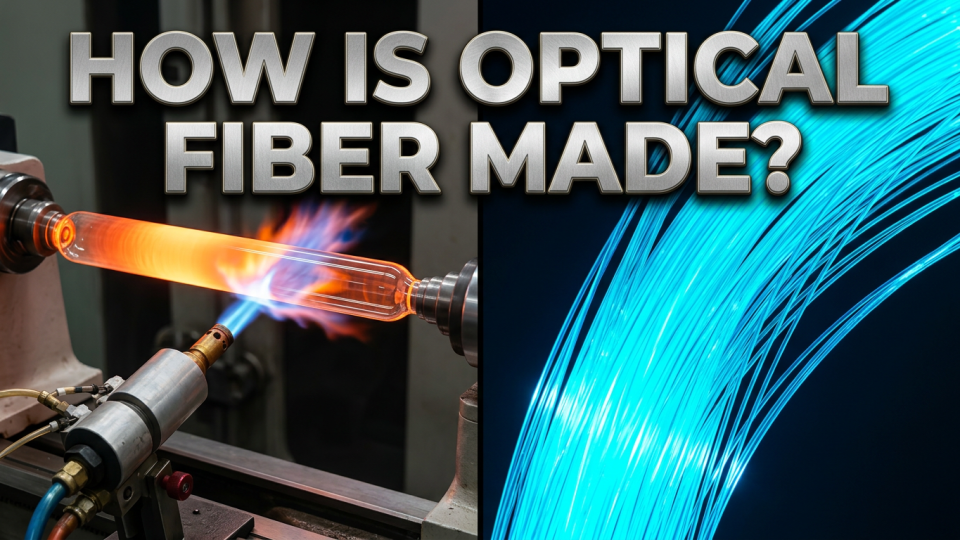
Preform manufacturing — MCVD, OVD, and VAD: There are several methods for manufacturing optical fiber preforms. Modified Chemical Vapor Deposition (MCVD), one important approach, uses a hollow quartz tube rotating on a precision lathe. Reactive gases (silicon tetrachloride, germanium tetrachloride, and oxygen) flow through the tube while a traversing torch heats it externally at 1,600 to 1,800°C, causing chemical reactions that deposit ultra-thin glass layers on the inner wall. Varying germanium content in each layer creates different refractive indices, building the optical structure of the future fiber at a scale engineers can inspect and control. After deposition, the tube is heated further until it collapses inward, transforming from a hollow tube to a solid glass rod. This rod is the preform — and this is the manufacturing secret most people never expect: they don’t try to make thin glass directly. They first build a giant version of the fiber. A modern large preform measures 2 to 3 meters long with diameters up to 300 millimeters. It holds the entire optical structure of the future fiber, but at a scale you can hold, inspect, and measure.
The draw tower: 2,000°C, 180 km/h, 125 microns: The preform is mounted at the top of an industrial draw tower 30 to 45 meters tall. The preform tip is lowered into a graphite furnace heated to over 2,000°C. The glass softens. A viscous neck forms at the base of the hot zone. A precision drawing mechanism at the tower base applies tension and pulls the neck downward. Only the very tip of the preform is hot. Only the tip stretches. The thick preform above remains cool and solid. As the fiber emerges, it travels at speeds up to 50 meters per second — 180 kilometers per hour — and is nearly invisible to the naked eye. A single large preform can produce over 1,000 kilometers of fiber. Laser gauges monitor the diameter several hundred times per second, and it must stay within plus or minus one micron of 125 microns for the entire draw.
Cooling and coating: After leaving the furnace zone, the fiber cools in helium-filled cooling tubes extending more than 10 meters down the tower. The bare glass is extraordinarily strong — freshly drawn fiber can support extraordinary tensile loads — but it is vulnerable to surface damage. UV-cured acrylate polymer coating is applied immediately: a soft primary coating expanding the diameter to 190 microns, then a harder secondary coating to 250 microns. Both are cured instantly by UV lamps as the fiber races past.
Total internal reflection: the physics of light confinement: The core of the fiber has a higher refractive index than the surrounding cladding. When light traveling through the core reaches the core-cladding boundary at a shallow enough angle, it undergoes total internal reflection — it is completely reflected back into the core. Not partially — completely. The light cannot escape. It propagates forward through the fiber, bouncing at the boundary, losing remarkably little energy over hundreds of kilometers. This property is built into the fiber during manufacturing by controlling the germanium concentration in each deposited glass layer — more germanium creates a higher refractive index.
Testing: proof testing and attenuation: Every fiber must pass mechanical proof testing — the fiber is continuously stressed to verify it has no microscopic flaws. Optical attenuation testing measures how much light is lost per kilometer. The best commercial fiber achieves 0.15 dB/km at 1550nm. Environmental, dimensional, and optical tests verify the fiber will survive installation, temperature extremes, and decades of service.
From fiber to cable to ocean floor: Multiple fibers are bundled into cables with strength members, water-blocking materials, and armored jackets. A single cable may contain hundreds of fibers. Over 597 submarine cable systems were active or under construction in 2025, spanning more than 1.2 million kilometers of ocean floor. Cable-laying ships carry the cable in enormous tanks and pay it out slowly as they cross oceans — sometimes over 5,000 meters of water beneath.
The internet doesn’t travel through the air alone. Much of the world’s information travels through threads of glass. Glass thinner than a human hair.
