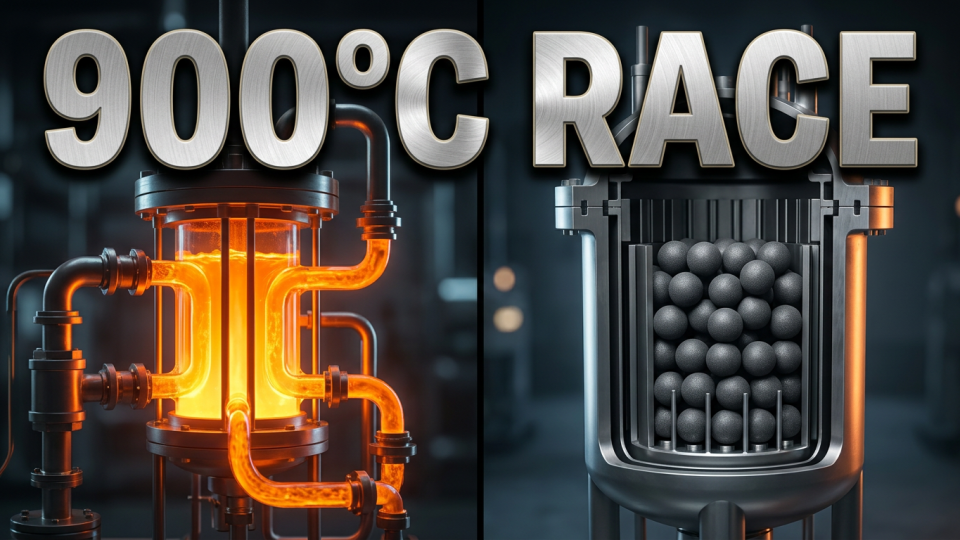
The Industrial Heat Race | MSR vs HTGR: Which Nuclear Reactor Wins?
Steel mills, cement kilns, and chemical plants produce more CO₂ than all the world’s cars combined. Not from electricity — from heat. Temperatures above 900 degrees Celsius that no solar panel or wind turbine can ever reach. Two radically different Generation IV nuclear reactor designs are racing to solve this. One uses liquid salt. The other uses fuel the size of a poppyseed.
This is the complete technical comparison of Molten Salt Reactors (MSR) and High-Temperature Gas-cooled Reactors (HTGR), specifically for industrial process heat applications: hydrogen production, steel via direct reduced iron, and cement decarbonization.
What we cover:
The heat problem: why electricity alone fails: Industrial processes require sustained temperatures of 700–1,500°C. Heat pumps lose efficiency above 200°C. Electric resistance heating becomes economically unviable at industrial scale above 500°C. This creates a thermodynamic wall that only advanced nuclear can cross. Industrial heat accounts for 8–10% of all global greenhouse gas emissions — and it is among the hardest to decarbonize.
The temperature spectrum: Not one problem but a spectrum. Hydrogen via high-temperature steam electrolysis needs above 800°C. Cement calcination requires around 900°C. Direct reduced iron steel needs 700–900°C. Advanced chemical synthesis can require 950°C and above. Every 50 degrees of reactor outlet temperature opens or closes specific industrial markets worth trillions of dollars.
MSR deep dive: FLiBe salt and liquid fuel: The Molten Salt Reactor uses FLiBe — fluorine, lithium, beryllium- as both coolant and, in some designs, fuel carrier. FLiBe stays liquid from 450°C to 1,400°C — a 950-degree liquid range no conventional coolant can match. In a liquid-fuel MSR, uranium is dissolved directly into the salt. No solid fuel rods. Continuous refueling without shutdown. And the freeze plug: a plug of frozen salt at the reactor base, held solid by a cooling fan. If power fails, the fan stops, the salt melts, and the liquid fuel drains by gravity into a passively cooled dump tank below. No pumps. No operator action. Physics makes it safe. Near-term commercial MSR designs deliver outlet temperatures of 600–700°C.
HTGR deep dive: TRISO fuel and 950°C helium: The High-Temperature Gas-cooled Reactor uses inert helium gas as its coolant — non-radioactive, non-corrosive, incapable of changing phase into steam. Each fuel element contains thousands of TRISO particles roughly the size of a poppyseed (approximately 1mm). Inside each particle: a uranium kernel surrounded by three independent layers of carbon and ceramic. The US Department of Energy calls TRISO “the most robust nuclear fuel on Earth.” Each ceramic layer independently contains radioactive fission products. TRISO particles can withstand temperatures above 1,600°C — 650°C above the reactor’s maximum operating temperature. The fuel physically cannot melt down. China’s HTR-PM, the only TRISO reactor in commercial operation as of 2026, operates at 750°C. Advanced HTGR designs target 950°C and above.
Head-to-head comparison:
On temperature: HTGR currently leads. MSR near-term commercial designs reach 600–700°C. Advanced HTGRs reach 750–950°C. HTGR crosses the thresholds for hydrogen and cement. MSR does not in current near-term designs.
On heat transfer efficiency: MSR leads. The temperature drop across a molten salt heat exchanger is approximately 280°C. For helium, it is 415°C. This means MSR delivers more usable heat per degree of reactor temperature to the industrial process.
On corrosion: HTGR has the simpler engineering challenge. Molten fluoride salts are extraordinarily corrosive to most metals and alloys. Finding materials that survive decades of contact with hot fluoride salt is one of the most demanding metallurgy problems in engineering. Helium corrodes nothing.
On deployment timeline: China’s HTR-PM is already operating commercially. Kairos Power’s Hermes demonstration reactor at Oak Ridge targets 2026. X-energy’s Xe-100 HTGR targets commercial operation in the early 2030s. For MSRs, Terrestrial Energy and Moltex target the late 2020s to early 2030s for demonstration plants.
Industry match results:
Hydrogen production (800–900°C required): HTGR wins on temperature. MSR at 650°C falls below threshold without efficiency penalties.
Cement decarbonization (900°C required): HTGR is the closer match today. Global cement production reached 4.1 billion tonnes in 2024. Decarbonizing half would eliminate roughly 1.5 billion tonnes of CO₂ per year.
Steel via direct reduced iron (700–900°C): Both can compete. HTGR serves the full range at 950°C. MSR at 700°C serves the lower end with better heat transfer efficiency. The right choice depends on the required operating temperature.
The verdict: There is no single winner. HTGR leads on temperature- it can reach where MSR cannot yet go. MSR leads on heat transfer efficiency and pressure safety. The smartest industrial strategies will likely deploy both- matching reactor type to the temperature fingerprint of each specific industrial process. The factories of tomorrow will look very different from those running today on natural gas and coal.
