Paper Title: Explainable machine learning for early identification of weak professional identity among pre-service early childhood teachers in China
Authors: Meijing Chen, Kah Choon Low, Zarina Zulkifli, Say Lee Chong, Peizhi Zheng
Corresponding Author: Kah Choon Low(kahchoonlow@163.com)/Malaysia
Abstract
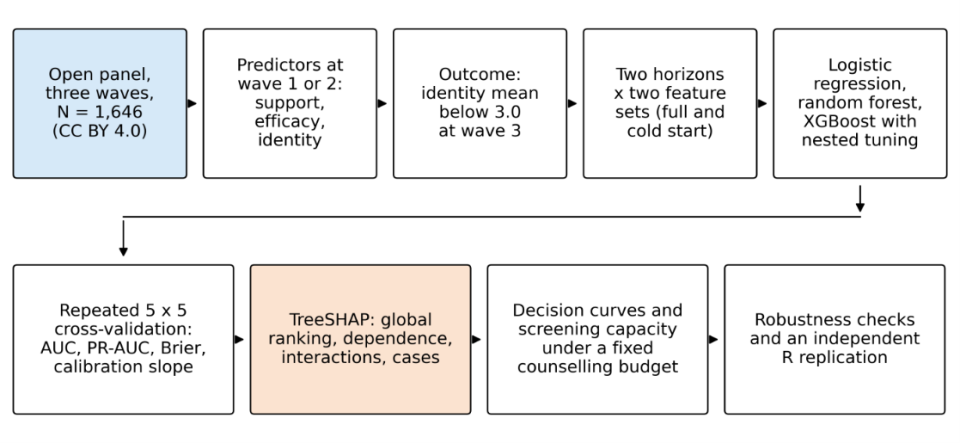
Teacher education programs rarely know which of their students will finish training with a weak sense of themselves as teachers, although such students may be more likely to leave the profession early. This study examined whether weak professional identity among pre-service early childhood teachers in China can be predicted one or two survey waves in advance. We analyzed an open three-wave panel of 1,646 students, trained logistic regression, random forest, and XGBoost models on measures of teacher support, teaching efficacy, and identity, and interpreted the predictions with SHapley Additive exPlanations (SHAP). XGBoost reached an area under the curve (AUC) of 0.712 from first-wave data and 0.749 from second-wave data, and its predicted risks were well calibrated. Logistic regression performed almost as well. Prior identity accounted for most of the predictive accuracy, since a model using first-wave identity alone reached 0.709. Support and efficacy sharpened the separation of individual risk estimates and showed where each student’s risk came from. A model built from five subscales of support and efficacy plus demographics, without any identity items, still reached 0.677. Volitional identity, a student’s commitment to choosing teaching, was the strongest predictor, and students scoring below 3.0 on it were nearly three times as likely as others to report weak identity two waves later. A program able to counsel one student in five would reach about two in five of the students later at risk, and about half of the students it selected would be true cases.

A multimodal deep learning model integrating visual features and early comment sentiment