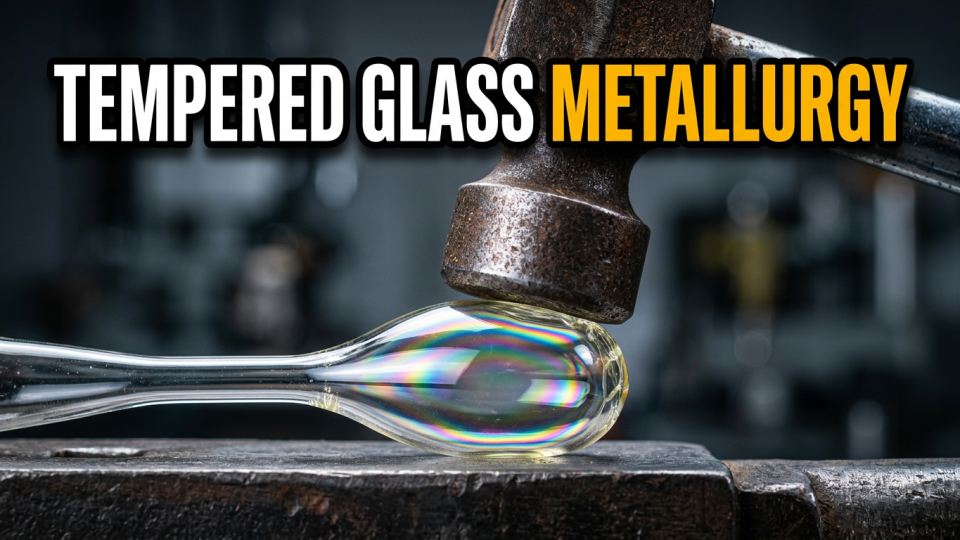
The Hidden Metallurgy of Glass | Why Tempered Glass Never Shivers
A hammer can’t break it. A bullet can dent it. But snap this tiny glass tail, and it explodes into 10,000 pieces in under a millisecond. This is a Prince Rupert’s Drop. And the same physics that makes it nearly indestructible is locked inside every car window, shower door, and skyscraper glass panel you have ever touched.
Tempered glass is a $112 billion global industry, and its extraordinary strength comes from something counterintuitive: intentionally creating a hidden internal war inside the material. Same atoms. Same chemistry. Just a controlled temperature war that changes everything.
The complete physics and engineering:
The Prince Rupert’s Drop, physics taken to its extreme: A Prince Rupert’s Drop is formed by dripping molten glass into cold water. The outer surface quenches so violently that surface compressive stress reaches approximately 700 megapascals, comparable to hardened steel. The bulb can survive a direct hammer blow, a vice grip, even a bullet impact without breaking. But touch the thin tail, and a crack enters a region where tension is close to the surface. That crack accelerates through the interior at up to 1,500 meters per second, releasing all stored elastic energy simultaneously. The drop explodes into dust in milliseconds. This is the same physics, scaled and controlled, that operates inside every tempered glass panel in the world.
Float glass and annealing, the starting point: Every piece of tempered glass begins as ordinary annealed glass. Float glass is produced by floating molten glass on liquid tin, forming a continuous flat ribbon. Annealing cools it slowly through a controlled temperature gradient in a long tunnel furnace called a lehr — allowing the molecular structure to relax uniformly with almost no internal stress. Annealed glass is optically perfect and cheap. It is also dangerously weak. Unlike steel, glass has essentially zero plastic deformation before fracture. A crack initiating at any surface flaw, a scratch, a chip, an edge defect, propagates at hundreds of meters per second across the entire pane, producing long razor-sharp shards.
The quenching process, creating the internal war: The tempering process heats annealed glass to approximately 650°C, just below its softening point. At this temperature, all prior internal stresses are relieved, and the glass becomes slightly viscous. The critical step: the hot glass exits the furnace and immediately enters a quenching zone where high-pressure air jets blast both surfaces simultaneously. The surface cools from 650°C to below the glass transition temperature in seconds. The interior lags, still too hot to respond. As the interior finally cools and tries to contract, the already-rigid surface resists. The surface is pulled into compression; the interior is pulled into tension. This stress state is permanent.
Compression vs tension, the tug-of-war that creates strength: The outer 20–30 percent of the glass thickness on each side is locked under surface compression of at least 69 megapascals, 10,000 PSI. The central 40–60 percent of the thickness is under equal balancing tension. Glass always fails by tensile cracking; a crack can only grow when the material at its tip is being pulled apart. Any crack initiating at the compressed surface must first overcome 10,000 PSI of compression before it can propagate. The crack tip encounters compression and stops dead. This is why tempered glass is 4 to 5 times stronger than annealed glass of identical composition. The strength comes entirely from manufactured stress, not from adding any material or changing any chemistry.
Breakage pattern: why tempered glass shatters into granules. When tempered glass fails, from an edge impact, a manufacturing defect, or a nickel sulfide inclusion, it fails completely and simultaneously. All the stored elastic energy in the tension zone releases at once, driving crack propagation at enormous speeds through the entire pane. But the fracture pattern is designed to be safe: the released tension shatters the glass into thousands of small, blunt cubic granules rather than long, sharp shards. This is identical to the fracture pattern of a Prince Rupert’s Drop disintegrating from its tail.
Edge vulnerability: The edge of a tempered glass pane has lower compressive stress than the face, a result of three-dimensional quenching geometry. A sharp blow or chip to the edge can introduce a crack directly into the central tension zone, bypassing the protective surface compression entirely. This is why all tempered glass edges are precisely ground and polished before tempering, and why edge protection in frames and gaskets is critical for architectural applications.
Nickel sulfide inclusions, the hidden time bomb: During float glass manufacturing, microscopic nickel sulfide (NiS) particles form when nickel from stainless steel equipment reacts with sulfur in raw materials. Typically 0.05–0.5 mm in diameter and invisible to the naked eye, these particles are trapped in a high-temperature beta-phase crystal structure during quenching. Over months or years after installation, they slowly transform to a denser alpha-phase, expanding slightly. If located in the tension zone, this expansion can exceed the glass’s local strength and trigger spontaneous fracture without warning — days, months, or years after installation. Spontaneous breakage from NiS inclusions occurs at approximately 1 per 10,000 m² of standard tempered glass. Heat soak testing — reheating tempered glass to approximately 290°C for several hours- accelerates the phase change and causes contaminated panels to shatter safely in the factory. Heat soak testing eliminates 90–95 percent of dangerous NiS inclusions, reducing spontaneous field breakage to approximately 1 per 1,000,000 m².
Applications where tempered glass is mandatory: Automotive side and rear windows (tempered glass shatters into blunt granules, allowing occupant escape from a trapped or submerged vehicle); shower enclosures (eliminates razor-sharp shard hazards in wet environments); building facades, entrance doors, and interior partitions within reach of people; oven doors (thermal shock resistance). Windscreens use laminated glass instead — two glass plies bonded with a polyvinyl butyral (PVB) interlayer that holds the broken pane together, maintaining driver visibility and wind protection. Tempered and laminated glass serve different safety objectives: one shatters safely into blunt granules, one holds together safely when broken.
Same atoms. Same chemistry. Just a controlled thermal war — and ordinary glass becomes 4× stronger, invisibly locked in a permanent state of internal conflict that keeps you safe every day.
