Paper Title: Digital-twin-oriented urban material planning for seasonal heat mitigation: a static Xujiahui case study
Authors: Wang Zhongzhuang, Cristina Amor Rosales, Anton Louise De Ocampo
Corresponding Author: Anton Louise De Ocampo (antonlouise.deocampo@ieee.org)/Philippines
Abstract
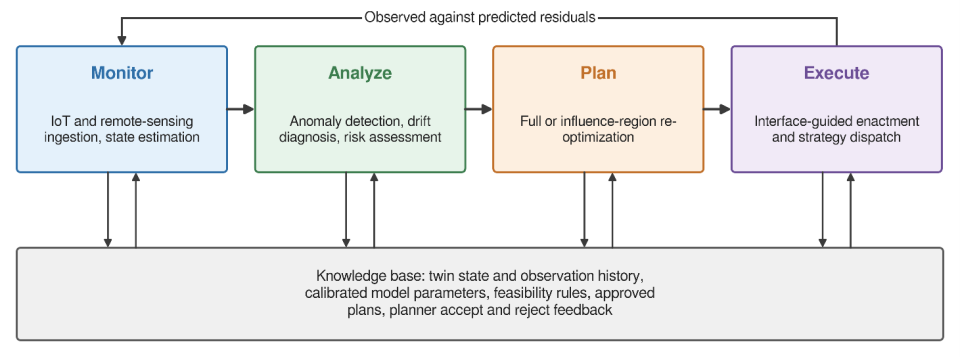
Material choice is one of the few levers a city has against summer radiant exposure, but a surface chosen for August remains in place in January. This study builds a digital-twin-oriented planning framework for 63 parcels in Xujiahui, Shanghai, China, combining a simplified radiative model with an Extreme Gradient Boosting (XGBoost) surrogate and a physics-constrained genetic algorithm (PC-GA). Corrected exterior-ground sky-view factors and 14 source-linked optical material analogs yield 37,800 synthetic radiative labels. On spatial and material holdouts, the surrogate reaches summer root mean square errors (RMSE) of 0.495 to 1.240 °C against the radiative generator. Across 30 seeds at 4,860 evaluations per run, PC-GA attains the lowest mean surrogate summer objective, 55.703 ± 0.253 °C, and the highest three-objective hypervolume, 0.592, of the four methods compared. Direct evaluation under 30 shared synthetic forcing realizations gives a summer-oriented plan 1.484 °C of cooling in mean radiant temperature (MRT). The same plan lowers winter MRT by 1.819 °C, a seasonal cost. Cooling survives every sky-view factor perturbation tested. Observational calibration and operational feedback remain to be built.
