Paper Title: Multi-agent generative AI ecosystems for cyber-physical systems in Industry 5.0
Authors: Kanaparthi Anil Kumar, K Hemachandran
Corresponding Author: Kanaparthi Anil Kumar (anilkds.85@gmail.com)/ India
Abstract
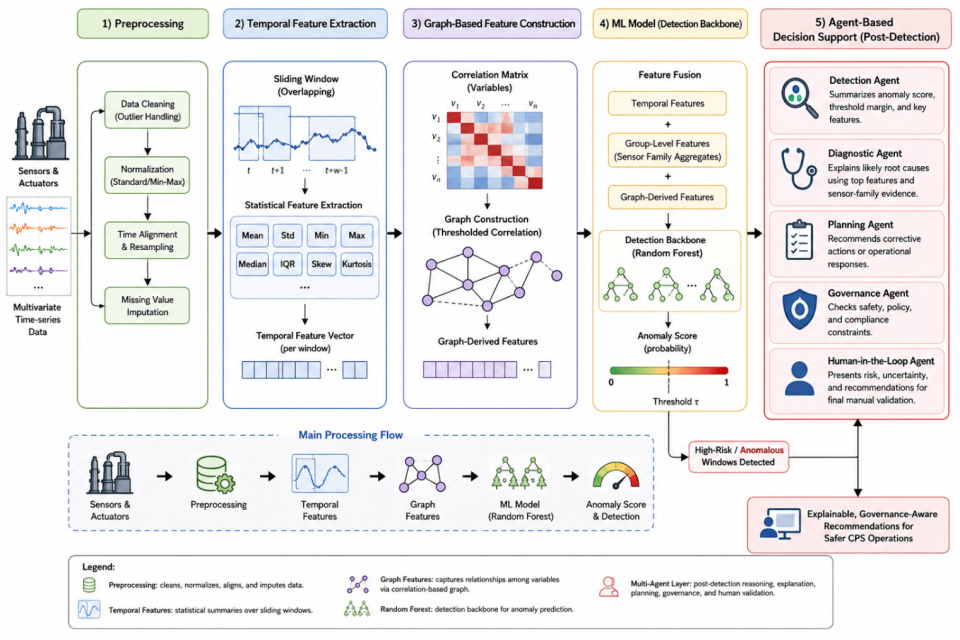
Cyber-Physical Systems (CPSs) are increasingly being implemented in critical industrial infrastructure, where complexity and interdependence are rising, posing significant cyber and operational risks. Traditional anomaly detection algorithms can be ineffective in capturing temporal dynamics, relational dependencies, and interpretable response requirements. The present paper proposes a multi-agent generative AI system to detect CPS anomalies and provide decision support by combining temporal feature encoding, relational modeling as graphs, supervised learning, and reasoning with an LLM. The architecture consists of detection, diagnosis, planning, governance, and human-in-the-loop validation agents. The framework is tested on the SWaT benchmark data. Findings indicate that the Autoencoder, LSTM, and 1D-CNN are more effective in terms of raw detection metrics, whereas the Random Forest provides more interpretable and agent-readable evidence to support the post-detection decision. Analysis of features and sensor family suggests the relevance of relational dependencies in characterizing anomalies. The multi-agent layer converts selected anomaly predictions into context-dependent explanations and governance-filtered recommendations to aid operator review, response planning, and process resilience. Overall, the framework supports transparent and human-supervised CPS anomaly management aligned with Industry 5.0 principles.
