Paper Title: Split-CNN for intrusion detection: enhancing feature diversity and training efficiency through channel separation
Authors: Harish G N, Annapurna H S
Corresponding Author: Harish G N (annapurnahs@ssit.edu.in)/India
Abstract
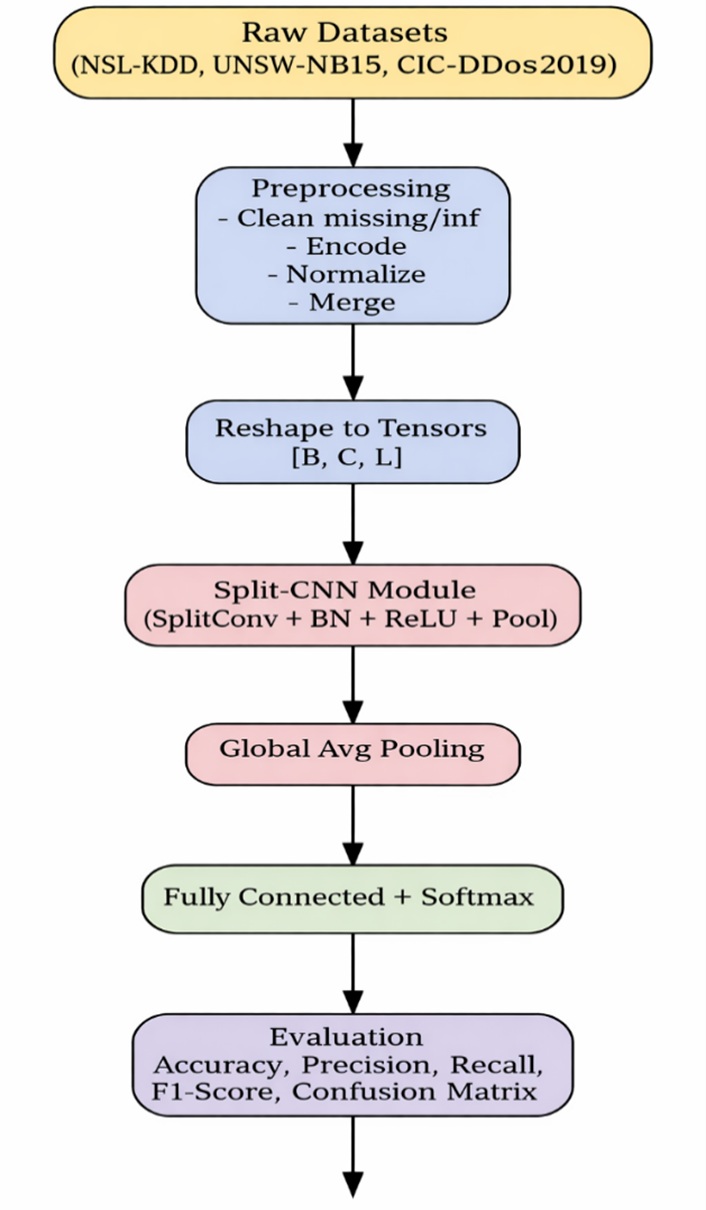
Cyber threats are becoming more sophisticated, and advanced intrusion detection systems (IDS) are needed to detect complex attack patterns on the network. Traditional IDS approaches tend to rely on signature-based methods or manually engineered statistical features, which struggle to detect evolving cyber threats and large-scale network traffic. The paper presents an intrusion detection framework that leverages a deep learning architecture, the Split Convolutional Neural Network (Split-CNN), which enhances feature diversity and training efficiency. Another module, Split Convolution (SplitConv), is proposed in the given model and isolates input feature channels into a few semantic groups, then performs separate convolution processes. This mechanism is interrelated with the decrease in inter-channel redundancy and the increase in discrimination feature learning. To facilitate cross-dataset learning, a feature alignment framework is proposed that can be unified to integrate three standard intrusion detection datasets: NSL-KDD, UNSW-NB15, and CIC-DDoS2019. The preprocessing pipeline includes categorical encoding, feature standardization, and dataset harmonization to construct a single dataset containing 168 features that constitute the four semantic channels. It has been demonstrated that the Split-CNN model is superior compared to the baseline CNN models in both classification and detection accuracy. These findings imply that the proposed approach can provide an effective, scalable deep learning system for contemporary network intrusion detection systems.
Keywords
Intrusion detection system, Split convolution, Feature diversity, Deep Learning, Network security, Channel redundancy
Cite:
G N, H., & H S, A. (2026). Split-CNN for intrusion detection: enhancing feature diversity and training efficiency through channel separation. Future Technology, 5(3), 35–44. Retrieved from https://fupubco.com/futech/article/view/837
