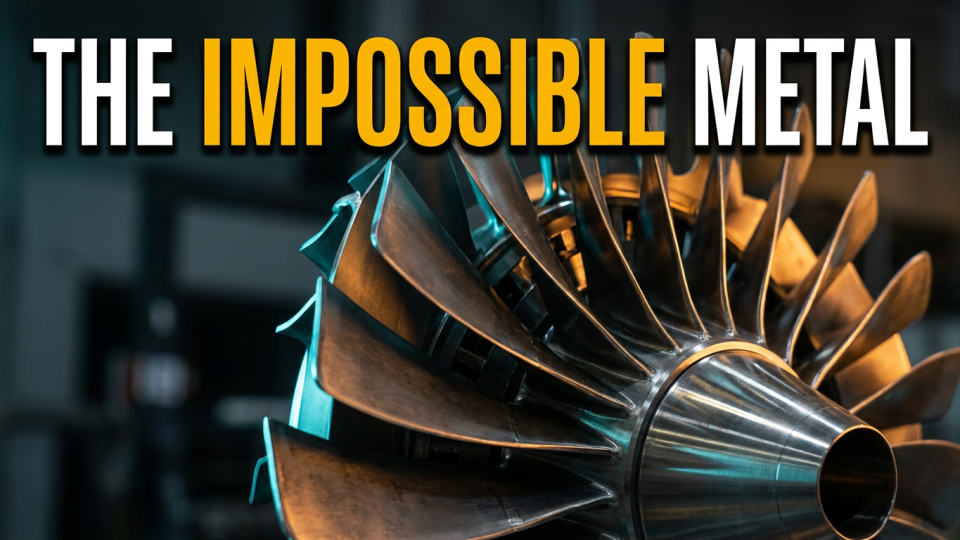
How Titanium Is Made | The Wonder Metal Powering Aerospace
Inside a jet engine spinning at 15,000 RPM. Inside a hip implant living in a human body for 30 years without corroding. Inside the hull of a deep-sea submersible at 600 atmospheres of pressure. One metal does all three — stronger than steel at less than half the weight. This is titanium. And making it requires one of the most chemically violent processes in industrial metallurgy.
Unlike iron or aluminum, titanium cannot be made by melting ore with carbon. Molten titanium instantly bonds with oxygen, nitrogen, and carbon, becoming brittle and contaminated. The solution is the Kroll process: a sealed, multi-stage chemical reaction that remains the only industrial method for producing titanium metal on Earth.
The complete science:
From sand to slag, rutile and ilmenite: Titanium is the ninth most abundant element in Earth’s crust. Its primary ore minerals are rutile (TiO₂ at 95%) and ilmenite (FeTiO₃ at 51% TiO₂), concentrated in coastal heavy mineral sand deposits in Australia, Mozambique, South Africa, and Canada. After mining, gravity and magnetic methods separate the mineral sands. Ilmenite is upgraded to titanium slag or synthetic rutile by smelting in electric arc furnaces at over 1,600°C to remove iron, producing a high-TiO₂ feedstock.
Chlorination, making TiCl₄: The upgraded TiO₂ enters a fluidized-bed chlorinator at 800–1,000°C with chlorine gas and petroleum coke. The reaction produces titanium tetrachloride (TiCl₄), a colorless liquid at room temperature. Raw TiCl₄ contains impurities, including iron, vanadium, and silicon chlorides, which fractional distillation removes (TiCl₄ boils at just 136°C, below most contaminants). Purified TiCl₄ is the critical intermediate for the Kroll process.
Why carbon reduction fails, and why argon matters: At high temperature, molten titanium instantly bonds with oxygen, nitrogen, and carbon, becoming brittle and contaminated. The carbon reduction that works for iron is catastrophic for titanium. The Kroll process solves this by using a sealed steel retort purged with argon gas — eliminating all reactive gases before the reaction begins.
The Kroll process — TiCl₄ + 2Mg → Ti + 2MgCl₂: Liquid magnesium is charged into the argon-filled retort. Purified TiCl₄ vapor is fed in at over 800°C. The exothermic reaction is immediate: magnesium reduces the titanium tetrachloride, depositing pure titanium as a grey porous solid on the reactor walls — titanium sponge. Each production cycle lasts about 10 days. After the reaction, vacuum distillation removes residual magnesium and MgCl₂ and recycles them. The Kroll process has been the only industrial titanium production method for over 70 years. China produced approximately 260,000 tonnes of sponge in 2025 — 70% of global output of 370,000 tonnes. The United States produced zero tonnes in 2025 after its last plant closed in 2024.
Titanium sponge, crushing, grading, and global supply: The purified sponge is crushed hydraulically into smaller pieces and graded by purity and particle size. Aerospace-grade sponge goes to VAR furnaces; lower grades go to less critical applications. Japan (53,000t), Kazakhstan, and Saudi Arabia supply most Western aerospace-certified sponge.
Ti-6Al-4V and Vacuum Arc Remelting: Crushed sponge is blended with precisely 6% aluminum and 4% vanadium to produce Ti-6Al-4V, the world’s most important titanium alloy (50% of all titanium use, 60+ years of commercial aviation service, tensile strength >900 MPa, density 45% below steel). The blend is compacted into large cylindrical electrodes and loaded into Vacuum Arc Remelting furnaces. In VAR, a high-voltage electric arc melts the electrode in a high-vacuum, water-cooled copper crucible — the only container that can hold molten titanium without contamination. Two or three VAR passes produce homogeneous aerospace-grade ingots. The Ti-6Al-4V market reached $5.4 billion in 2026.
Forging, rolling, and machining: VAR ingots are forged and rolled into billets, bars, plates, sheets, and tubes at carefully controlled temperatures — too hot and titanium absorbs atmospheric gases, too cold and it cracks. Final CNC machining of titanium is uniquely challenging: low thermal conductivity concentrates heat at the tool tip, causing rapid wear; titanium work-hardens rapidly and springs back after cutting. Specialist tools, flood coolant, and slow cutting speeds are essential.
Applications: aerospace, medicine, deep sea. Aerospace consumes 42% of global titanium alloy demand. A modern wide-body aircraft contains up to 15% titanium by structural weight — fan blades, compressor discs, landing gear, structural members. Advanced fighter jets reach approximately 39% titanium by structural weight. Medical applications (19% of demand) include hip and knee replacements, spinal fusion cages, and dental implants — all titanium because the body cannot reject it. Deep-sea pressure hulls withstand 600 atmospheres. Titanium chemical reactors last decades in corrosive environments where steel would fail in months. Global titanium market: $29.84 billion in 2026.
From black mineral sand on a beach to a jet engine fan blade spinning at 15,000 RPM, titanium is one of the most extraordinary material journeys in modern engineering.
