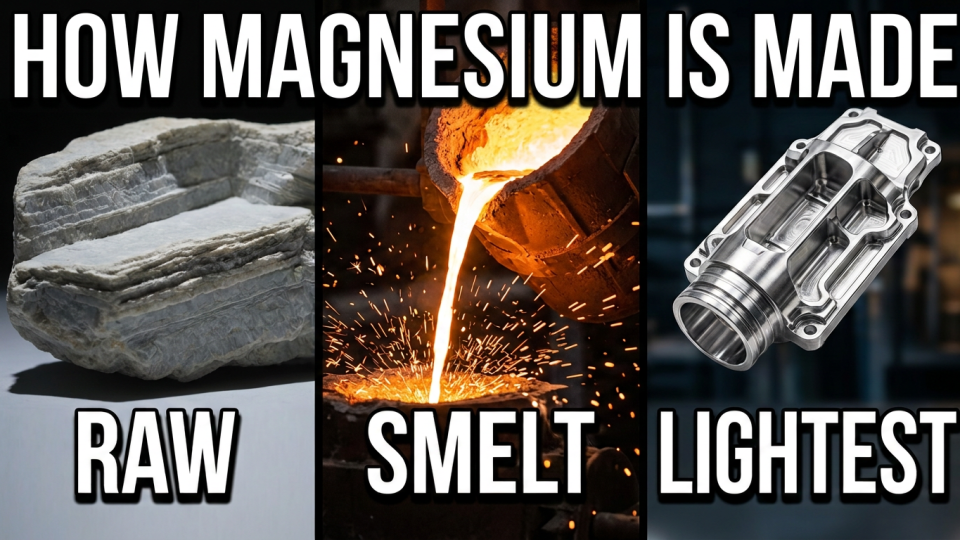
Magnesium | How the World’s Lightest Structural Metal Is Made
What if the lightest structural metal on Earth, one-third lighter than aluminum and four times lighter than steel, is hiding inside the ocean that covers 70 percent of our planet? Magnesium powers aircraft frames, EV chassis, and the process that makes titanium. And almost nobody knows how it is extracted.
This is the complete story of magnesium — from dolomite rock and seawater to jet engines, electric vehicles, and the titanium that goes into spacecraft.
The complete science:
The sources: dolomite and seawater: Magnesium is the eighth most abundant element in the Earth’s crust and the third most abundant dissolved element in the ocean. The primary solid source is dolomite — a pale grey carbonate rock containing roughly 13 percent magnesium by weight. Quarries extract millions of tonnes annually. The rock is crushed then calcined, heated to over 700°C, driving off CO₂ and producing magnesium oxide (dolime). The second source is seawater itself: every tonne contains approximately 1.3 kilograms of dissolved magnesium. Industrial coastal plants pump seawater, add lime to precipitate magnesium hydroxide, filter it, convert it to magnesium chloride, and prepare it for electrolysis. The ocean is an essentially inexhaustible magnesium mine.
The Pidgeon process: 1,200°C in vacuum: The dominant production method worldwide — accounting for approximately 76 percent of global production — is the Pidgeon process, used almost exclusively in China. Dolime is mixed with ferrosilicon (an iron-silicon alloy), compressed into briquettes, and loaded into horizontal steel retort tubes. These are heated in furnaces to approximately 1,200°C under vacuum below 1 millibar. At this temperature, silicon from the ferrosilicon reduces the magnesium oxide: 2MgO + Si → 2Mg(vapor) + SiO₂. The vacuum allows magnesium vapor to form at achievable temperatures. The vapor travels to the cooler end of the retort and condenses into a crystalline solid called a crown. After 8 to 12 hours, the retort is removed, cooled, and opened manually. The Pidgeon process is one of the most labor-intensive industrial metal production processes on Earth — and generates approximately 37 kilograms of CO₂ per kilogram of magnesium produced.
Molten salt electrolysis, the cleaner alternative: The second major route, favored in the West, uses electrolysis of molten magnesium chloride. Anhydrous magnesium chloride is melted in large ceramic-lined steel electrolytic cells at approximately 700°C. Electric current passes between a carbon anode and a steel cathode. Magnesium ions (Mg²⁺) migrate to the cathode and deposit as liquid magnesium metal, which floats to the surface and is collected by a ladle. Chlorine gas released at the anode is captured for recycling. Powered by renewable energy, this route offers dramatically lower CO₂ emissions than the Pidgeon process — making green electrolysis the key to sustainable magnesium production.
The metal: 650°C melting point, 7.5 kg ingots: Whether from the Pidgeon process or electrolysis, raw magnesium is melted at just 650°C, purified with fluxes, and cast into standard ingots typically weighing 7.5 kilograms each. These are shipped globally to alloy producers and die casters.
Alloying: AZ91D and rare earth alloys: Pure magnesium is too soft for most applications. The world’s most widely used magnesium alloy is AZ91D: 90 percent magnesium, 9 percent aluminum, 1 percent zinc. Aluminum dramatically increases strength and hardness. Zinc improves corrosion resistance. AZ91D is found in millions of die-cast components, including laptop casings, camera bodies, and automotive brackets. For aerospace and high-performance applications, rare earth elements, neodymium, cerium, yttrium, are added to improve creep resistance at elevated temperatures. Magnesium’s low melting point and excellent flow allow thin-wall die casting with walls as thin as 1 millimeter, lighter than any aluminum equivalent.
Critical applications: In aerospace, magnesium alloys reduce weight in helicopter gearboxes, aircraft seat frames, and missile components — every kilogram saved is fuel saved or payload gained. In electric vehicles, magnesium die castings replace aluminum in instrument panels, steering columns, and battery housings, extending driving range directly. In the Kroll process, the dominant method for producing titanium, liquid magnesium reduces titanium tetrachloride at high temperature: TiCl₄ + 2Mg → Ti(sponge) + 2MgCl₂. Without magnesium, there is no commercial titanium, no titanium jet engines, no titanium medical implants, no titanium spacecraft. Magnesium sacrificial anodes protect steel pipelines, ship hulls, and underground infrastructure by corroding first due to magnesium’s higher electrochemical activity than steel — one anode can protect hundreds of meters of pipeline for years.
The future: The global magnesium market reached $27.65 billion in 2024 and is projected to reach $42.98 billion by 2032 at a CAGR of 5.67 percent. Green electrolysis powered by renewable energy could transform magnesium from one of the most carbon-intensive metals to one of the cleanest. The lightest structural metal may also become one of the greenest.
