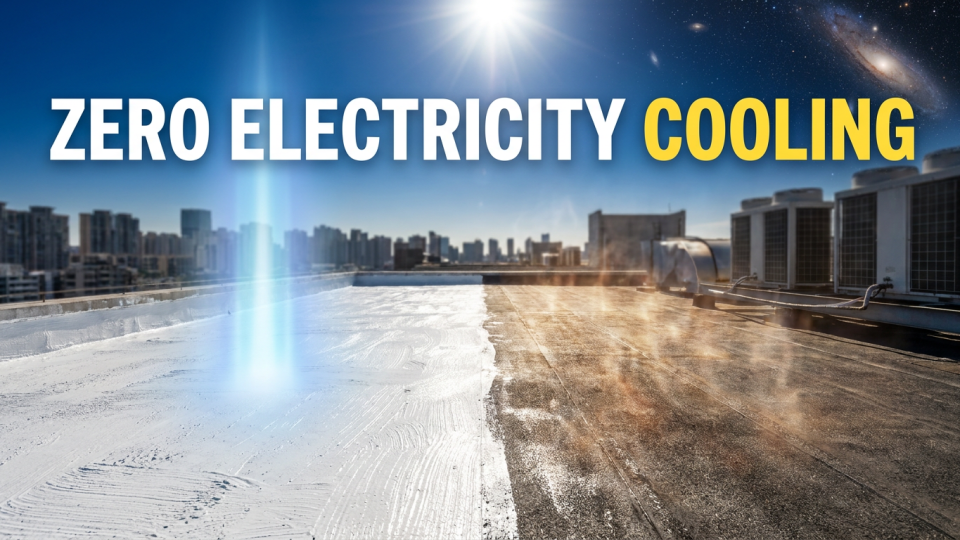
This Paint Sends Heat to Outer Space | The Physics of Zero-Electricity Cooling
Global cooling demand is accelerating toward a thermodynamic crisis. Air conditioning already consumes 15 percent of all electricity used in US buildings, and by 2050, global cooling will require more power than the entire current US grid produces. Traditional refrigeration has a fundamental flaw: it does not destroy heat — it relocates it, worsening the urban heat island effect in 450 cities worldwide, where temperatures already run 10 to 12 degrees hotter than in surrounding rural areas.
Passive Radiative Cooling paint solves this at the level of physics. Engineered with barium sulfate nanoparticles sized 400 to 500 nanometres to maximize Mie scattering, Purdue University’s breakthrough formulation reflects 98.1 percent of incoming solar radiation while simultaneously emitting thermal energy through the 8 to 13 micrometer atmospheric transparency window — a direct channel to the vacuum of deep space at minus 270 degrees Celsius. The result: surfaces reaching 4.5 degrees Celsius below ambient air temperature under direct sunlight, with a measured cooling power of 117 watts per square meter, using zero electricity and zero moving parts.
The ternary BaSO4-SiO2-hBN formulation achieves 12.8 degrees below ambient — the highest ever recorded. SkyCool Systems has deployed over 100,000 square meters across 20 commercial sites with measured HVAC savings of 21 percent in summer. 3M, Saint-Gobain, and BASF have committed dedicated capital expenditure. The radiative cooling materials market — valued at $1.2 billion in 2024 — is forecast to reach $3.5 billion by 2033 at a CAGR of 12.5 percent. Over 450 patents were filed between 2022 and 2025, a 3.4-fold increase. Simulations indicate that covering just 1 to 2 percent of Earth’s surface with PRC materials could stabilize global average temperatures through increased radiative heat loss to space.
