Paper Title: PoET²S: Folding a digital twin into validator selection for blockchain consensus in peer-to-peer energy trading
Authors: Zainab S Idan, Hussein Akeel Hussein Alaasam, Firas H. Neamah, Yahya Mahdi Hadi Al-Mayali, Hussein Alrammahi
Corresponding Author: Firas H. Neamah (firas.hammoodi@almaaqal.edu.iq)/Iraq
Abstract
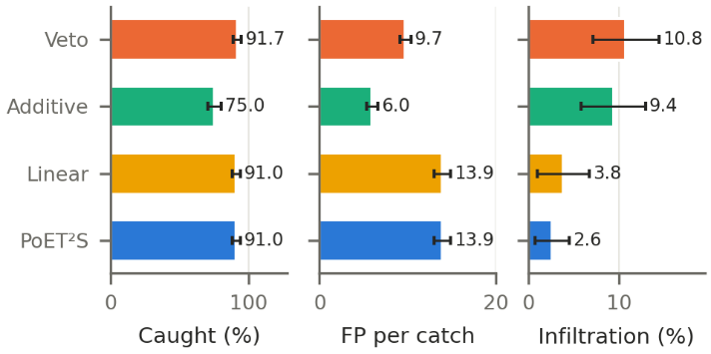
Blockchain platforms for peer-to-peer energy trading often add a digital twin that forecasts each meter’s generation and demand. In most designs the twin only raises alarms, while validators are still chosen by stake or computation. The proposed scheme, PoET²S, incorporates the twin’s evidence into validator selection: a node’s weight is a stake-and-energy term multiplied by its Twin-Trust Score raised to γ = 2.5, so nodes that contradict the physical forecast quickly lose committee seats. A discrete-event simulator compares PoET²S (500 nodes, 15% Byzantine, 30 paired seeds) with seven classical baselines and three design points from recent work: a binary veto, an additive energy-and-trust score, and a linear (γ = 1) reputation weight. Detection is a near-tie: PoET²S catches 91.0% of attackers and the veto 91.7%. PoET²S raises more false alarms per catch by default (13.9 against 9.7) but matches the veto’s catch rate at equal false-alarm cost. The malicious committee share is 10.8% under the veto, 3.8% under the linear weight, and 2.6% under PoET²S, and on 100 seeds the gain over the linear weight is 37% (Holm-adjusted p = 7.2 × 10⁻⁹). At 45% Byzantine nodes, the one-third fault bound fails in 64.4% of veto blocks and 2.4% of PoET²S blocks. Simulated commit latency (30.2 ms) is higher than for Proof of Stake and Delegated Proof of Stake, lower than for Practical Byzantine Fault Tolerance, and flat up to 4,000 nodes; an optional fast path lowers it to 26.8 ms. Against Sybil attacks, top-K selection needs certified meter identities.
