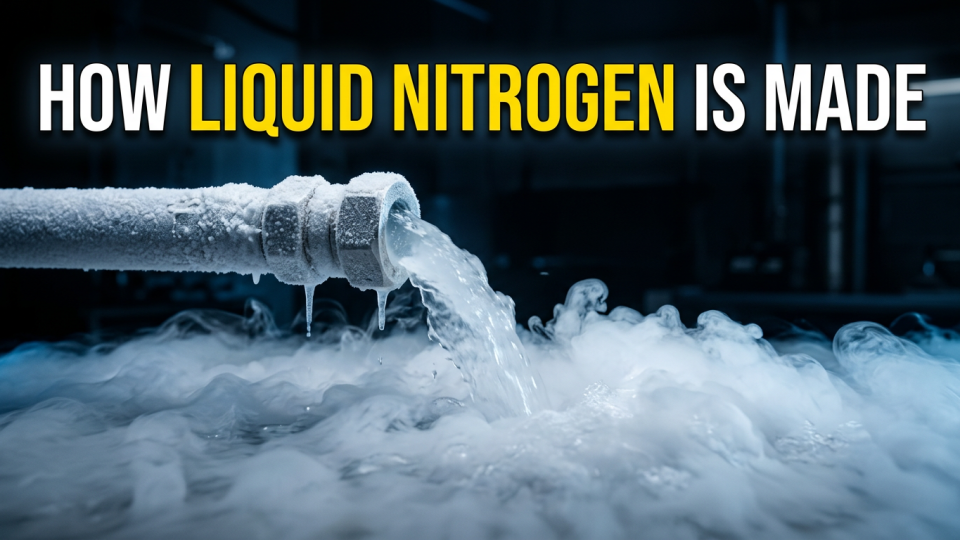
How Liquid Nitrogen Is Made
This liquid is boiling right now, at nearly minus 196 degrees Celsius. Colder than the coldest place on Mars’s surface. Yet we don’t manufacture it from scratch. We pull it from the air you are breathing right now. This is how engineers take ordinary atmospheric air, strip it down to minus 196 degrees, and produce one of the most useful liquids in modern science and industry.
The complete science:
The paradox: 78% nitrogen, but impossible to reach: Atmospheric air is approximately 78 percent nitrogen by volume. The raw material is everywhere. The challenge is cooling it to minus 195.8°C — colder than the surface of Pluto, and doing it continuously at industrial scale. A large modern air separation unit can produce thousands of tonnes of liquid nitrogen per day from nothing but air.
Air intake and purification: Industrial air separation plants draw in enormous volumes of atmospheric air through large inlet filters. But air also contains water vapor and carbon dioxide. The cryogenic system must remove these before they freeze solid at minus 196°C and block the equipment. Large molecular sieve vessels adsorb water and CO₂ before the air enters the cold section.
🔥 The compression paradox: Large industrial compressors raise the air pressure to several times atmospheric pressure, but compression makes air hotter, not colder. The cold comes later, through a precise sequence of heat exchange and controlled expansion. After compression, intercoolers remove the heat of compression before the air enters the cryogenic section.
Main heat exchanger and expansion cooling: The compressed air enters the main heat exchanger cold box, where incoming warm air continuously transfers its heat to the cold outgoing product streams. This energy recycling pre-cools incoming air using coldness already produced inside the system. The air then passes through cryogenic expansion turbines spinning at tens of thousands of RPM. As the compressed gas expands, its temperature drops dramatically, from room temperature to minus 100°C, minus 150°C, and then into the cryogenic range below minus 180°C, where the air begins to partially liquefy.
🏭 Fractional distillation — 12 degrees of difference: The partially liquefied air enters tall cryogenic distillation columns. Nitrogen boils at minus 195.8°C. Argon boils at minus 185.8°C. Oxygen boils at minus 183.0°C. Just 12 degrees separate nitrogen from oxygen, but that difference is enough to separate them completely by fractional distillation. Modern plants use a double-column system: a lower-pressure column and an upper-pressure column linked thermally. Nitrogen purity above 99.999 percent — five-nines purity — is achievable for the most demanding applications.
Liquid nitrogen storage: the 696× expansion: The separated nitrogen at cryogenic temperature is transferred to double-walled vacuum-insulated Dewar vessels or bulk storage tanks where it remains liquid for weeks. When liquid nitrogen warms to room temperature, it expands approximately 696 times in volume; one liter of liquid becomes 696 liters of gas. This is why liquid nitrogen must never be sealed in an ordinary closed container.
Applications: food, medicine, engineering: Liquid nitrogen enables rapid freezing that preserves food texture by creating smaller ice crystals than conventional freezing, used for ice cream, herbs, seafood, and specialty food processing. In medicine, it destroys abnormal tissue in cryotherapy and preserves biological samples in biobanks at minus 196°C for years. In precision engineering, shrink fitting uses liquid nitrogen to contract metal components so they slide into bores they wouldn’t fit at room temperature. In semiconductor manufacturing, nitrogen provides the inert atmosphere that excludes oxygen and moisture from sensitive processes.
Safety: frostbite, asphyxiation, and oxygen enrichment: At minus 196°C, direct skin contact causes severe frostbite instantly. Nitrogen gas is colorless and odorless; in enclosed spaces, it displaces oxygen, creating a silent asphyxiation hazard with no warning. Industrial facilities use fixed oxygen monitors and strict ventilation protocols. One final hidden hazard: because oxygen’s boiling point (minus 183°C) is higher than nitrogen’s (minus 195.8°C), extremely cold surfaces can cause oxygen in the surrounding air to condense onto them—creating oxygen-enriched zones that significantly increase fire and combustion hazards.
From the air around you to minus 196 degrees, liquid nitrogen is one of Earth’s most extraordinary industrial products.
