Paper Title: AI-driven liability assessment framework for autonomous systems integrating machine learning with EU and Indian regulatory models
Authors: Rishi Srivastava, Sadaf Fahim, Garima Singh, Koyel Roy, Arunanshu Dubey, Rahul Tiwari
Corresponding Author: Rishi Srivastava (rishisrivastava@csjmu.ac.in)/ India
Abstract
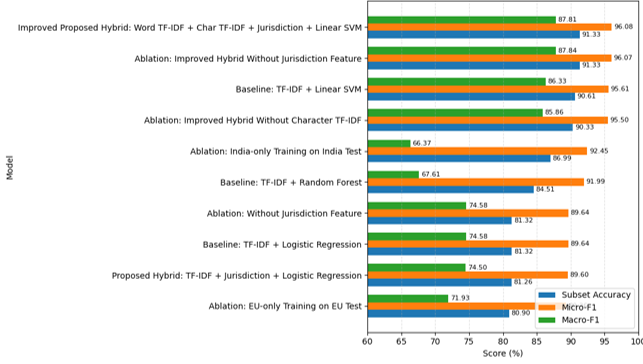
Autonomous systems pose liability issues when automated decisions contribute to harm, failure, or non-compliance with regulations. Current legal AI studies primarily focus on classification, retrieval, question answering, and judicial prediction, and little has been done to translate legal and regulatory texts into structured signals that convey liability-relevant information. This research paper proposes a decision-support model for categorizing liability cues under European Union and Indian law. The source datasets were MultiEURLEX and IndicLegalQA, and a rule-based proxy mapping was developed to assign five labels: damage, defect, liability, regulation, and risk. This model is based on word-level and character-level TF-IDF, jurisdiction encoding, and a One-vs-Rest Linear Support Vector Machine classifier for multi-label classification. The final best configuration had an overall 91.33% subset accuracy, 96.08% Micro-F1, 87.81% Macro-F1, and 0.0201 Hamming Loss, compared to the best configurations of Logistic regression, Linear SVM, and Rand Forest. The framework aids initial legal and regulatory analysis and does not decide liability on doctrinal grounds or substitute for proficient legal analysis.
