Paper Title: A framework for integrating artificial neural networks and finite element analysis for shear strength prediction in unreinforced RC beam–column joints
Authors: Ranim Maatouq, Rouya Hdeib
Corresponding Author: Rouya Hdeib (rouya.hdeib@gmail.com)/ Bahrain
Abstract
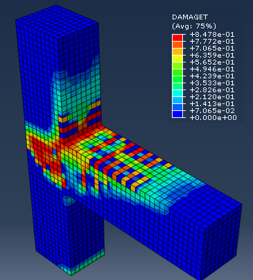
Beam-Column joints (BCJs) are critical components in reinforced concrete (RC) buildings. These members experience excessive stress during seismic events, often resulting in catastrophic failures, particularly in RC buildings constructed prior to the introduction of seismic design provisions and lacking reinforcement in the BCJ zone. The study presents a machine learning framework to predict the shear strength of unreinforced BCJs using 7 input parameters. This study developed an Artificial Neural Network-Finite Element Analysis hybrid model (ANN-FEA-13), trained, validated, and tested on 4320 samples of BCJ failure generated through nonlinear analysis in ABAQUS. The data was divided into training (70%), testing (15%), and validation (15%) sets. The ANN-FEA-13 model achieved high prediction accuracy (R = 0.962) and was compared with experimental data from literature and the ACI 318 code, showing superior performance. The results were promising and demonstrated the effectiveness of the developed data-driven ANN-FEA-13 framework, which reliably predicts BCJ failure and supports ongoing efforts in resilience-based assessment and retrofitting of aging RC structures in seismic regions.
