Paper Title: Cross-domain aspect-based sentiment analysis using DeBERTaV3 and bio-CRF: a syntactic-aware span extraction approach
Authors: Udayalaxmi Aditya Teki, P. Ranjana
Corresponding Author: Udayalaxmi Aditya Teki (udayalakshmiaditya123@gmail.com)/ India
Abstract
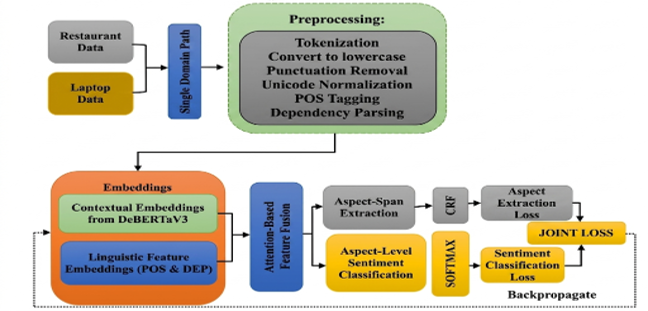
Aspect-Based Sentiment Analysis (ABSA) often experiences a significant performance decline in cross-domain settings due to vocabulary variation and domain-specific aspect expressions. Although transformer-based models achieve strong in-domain performance, they primarily rely on contextual embeddings and often ignore the syntactic structures that remain consistent across domains. Existing methods rarely integrate structured decoding with adaptive syntactic fusion for robust aspect boundary detection. This paper proposes a syntactic-aware cross-domain ABSA framework based on DeBERTaV3 and BIO-CRF decoding to alleviate the above problems. The proposed model introduces part-of-speech and dependency-relation embeddings, in addition to contextual embeddings, and uses an attention-based model to dynamically fuse syntactic and semantic information at multiple levels. We further apply a Conditional Random Field (CRF) layer to enforce valid BIO transitions and enhance the consistency of multi-word aspect spans under domain shift. The model was evaluated in three English review domains: Restaurant, Laptop, and Device across six zero-shot cross-domain transfer settings (D→L, D→R, L→D, L→R, R→D, and R→L). Test results show consistent advances over robust transformer-based and prompt-based baselines. The proposed method yields F1 scores for aspect extraction between 0.72 and 0.81 and achieves sentiment classification accuracies between 74.32% and 85.19%. The best performance was achieved in the L→R transfer setting. Through paired bootstrap testing (p < 0.01), Statistical analysis confirms that the proposed model achieves significant improvements over baseline methods. The results demonstrate that incorporating explicit syntactic knowledge, adaptive feature fusion, and structured decoding substantially improves cross-domain generalization in fine-grained sentiment analysis.
