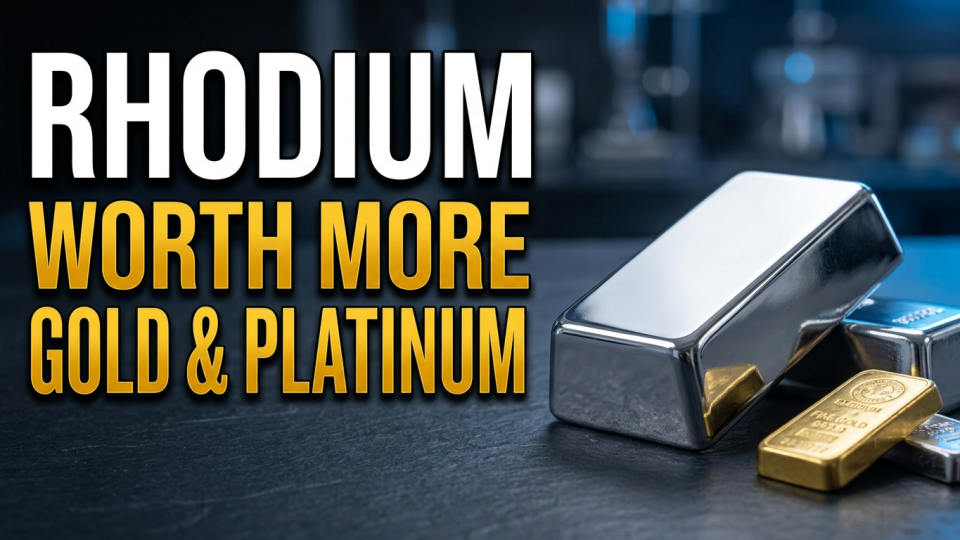
Rhodium: The $30,000 Metal Rarer Than Gold
This is one ounce of rhodium. In March 2021, it was worth nearly $30,000, more than gold and platinum combined. The entire world produces less than 30 tonnes per year. It fits in a single shipping container. And without it, every petrol car on Earth would be pumping toxic nitrogen oxides into the air. You have almost certainly never heard of it. But you have almost certainly depended on it every day of your life.
The complete science and supply chain:
The most expensive precious metal on Earth: Rhodium’s all-time high was $29,800 per troy ounce in March 2021 — driven by a perfect storm of South African mine disruptions, tightening global emissions regulations, and near-zero above-ground inventory. By late 2024, it had collapsed to $4,400. By October 2026, it had recovered to approximately $9,000 — still 3.4 times the price of gold. Annual global gold production is approximately 3,600 tonnes. Annual rhodium production is approximately 25 tonnes. The entire world’s rhodium supply fits in a single shipping container. No other critical industrial metal is this rare and this concentrated.
The platinum group metals, six elements that occur together: Rhodium (atomic number 45) belongs to the platinum group: ruthenium, rhodium, palladium, osmium, iridium, and platinum. These six transition elements are so chemically similar they are found together in nature. Rhodium has the highest reflectivity of any metal, over 80 percent of visible light. Its melting point is 1,964°C. It does not react with most acids at room temperature, does not tarnish in air, and maintains its properties above 1,900°C. Its crustal abundance is approximately 0.0002 parts per million, rarer than any element with significant industrial use.
The Bushveld Complex — 80 percent from one geological formation: Almost all of the world’s rhodium comes from South Africa’s Bushveld Complex — the largest layered igneous intrusion on Earth, stretching across an area the size of the United Kingdom. In 2025, South Africa produced 566,000 troy ounces of primary rhodium — approximately 81 percent of global mine supply of 701,000 ounces (21.8 tonnes). Russia’s Norilsk-Talnakh produced approximately 10–12 percent. Zimbabwe’s Great Dyke accounts for approximately 4–6 percent. There are no primary rhodium mines anywhere on Earth. Rhodium occurs only as a trace byproduct within platinum and palladium ore — typically less than one gram of rhodium per tonne of rock. Whether more rhodium is produced depends entirely on platinum and palladium miners’ decisions. Rhodium has no independent supply lever.
The extraction process, months of sophisticated metallurgy: The journey from rock to rhodium metal involves: froth flotation concentrating PGMs from 4–6 g/t to over 1,000 g/t in concentrate; electric arc smelting producing a PGM-rich sulfide matte containing all six platinum group metals; base metals refinery removing nickel, copper, and cobalt through hydrometallurgical and electrochemical steps; dissolution of the PGM-rich leach residue in aqua regia (a mixture of nitric and hydrochloric acid); and successive precipitation, solvent extraction, and ion exchange steps separating each PGM. Rhodium is among the most difficult PGMs to separate — adding months to the refining timeline and cost.
NOx reduction chemistry, why rhodium is irreplaceable: The three-way catalytic converter must simultaneously oxidize carbon monoxide, oxidize unburned hydrocarbons, and reduce nitrogen oxides. Platinum and palladium handle the oxidation reactions. Rhodium alone handles NOx reduction. The reaction: 2NO + 2CO → N₂ + 2CO₂. Rhodium’s surface geometry allows it to bind and split the nitrogen-oxygen bond with unmatched efficiency at automotive exhaust temperatures. No other affordable metal replicates this at scale. A modern petrol vehicle contains approximately 1 to 3 grams of rhodium. With 80 million new vehicles produced globally per year, the mathematics of demand is relentless.
The most volatile price chart in commodities: From under $1,000 per ounce in 2016, rhodium surged to $29,800 in March 2021 — a 3,000 percent increase in five years — then collapsed to $4,400 in 2024. The 2021 spike was driven by COVID mine disruptions cutting South African supply, tightening Euro 6 and China 6 emissions standards requiring higher rhodium loadings per converter, and near-zero above-ground inventory. No ETF holds rhodium at scale. The market is traded OTC between a handful of participants. A small supply shortfall can send prices to extreme levels. Rhodium closed 2025 up 94.72% and is up a further 14.71% year-to-date in October 2026.
The future- EVs, recycling, and hydrogen: Pure EVs have no exhaust and no catalytic converter — a long-term existential threat to rhodium demand. But with over 1.4 billion ICE vehicles on the road globally and the EV transition taking decades, demand remains robust. Hybrid vehicles still require full catalytic converters, sometimes with higher rhodium loadings. Secondary supply from recycling spent converters now provides approximately 25–30 percent of total rhodium supply — the fastest-growing supply source. Hydrogen fuel cells could eventually eliminate NOx emissions in heavy transport — but this transition remains decades away. Other applications, including fiberglass manufacturing (Pt-Rh bushings), nuclear neutron detectors, chemical process catalysts, and electroplating, are small by volume but impossible to substitute.
From the Bushveld Complex to your exhaust pipe — rhodium is the hidden bottleneck of modern emissions control. The most valuable, volatile, and overlooked metal in industrial civilization.
