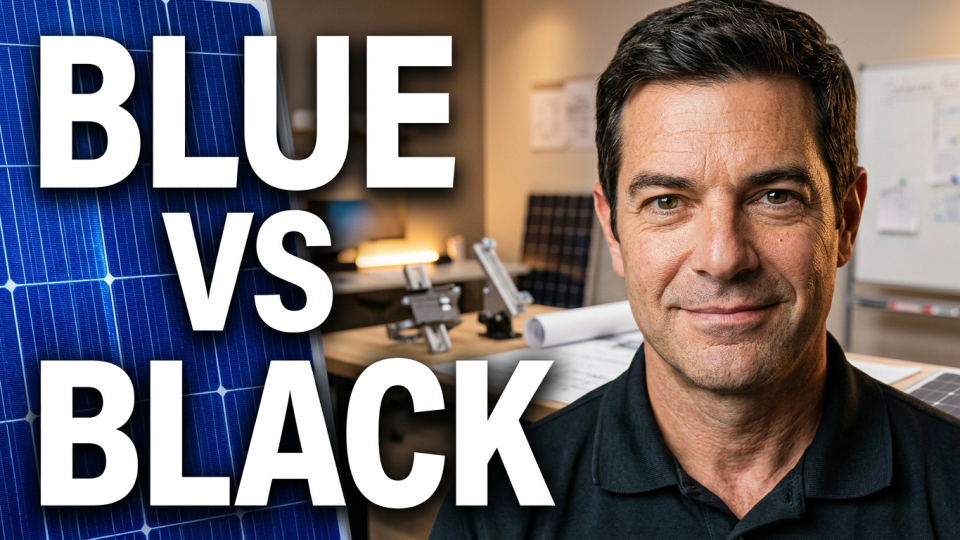
Why Blue Solar Panels Are Disappearing | Mono vs Poly Explained
If you look at solar installations from ten years ago, you see a lot of blue panels. Speckled, sparkly, distinctively blue. In 2025, almost nobody installs them anymore. Polycrystalline panels have gone from holding 40 percent of the market in 2015 to just 10 percent today. This video explains exactly why, and gives you an honest buyer’s guide that could save you thousands.
The science in plain language:
How they’re made: Monocrystalline panels use the Czochralski method, a single perfect silicon crystal grown like a diamond. Polycrystalline melts silicon fragments together in a mold. As the mixture cools, hundreds of crystals form, each pointing in a different direction. The result looks like a mosaic. And like a mosaic, it has seams.
Why seams matter: When sunlight hits a solar cell, it knocks electrons loose. In a single crystal, those electrons flow freely, like cars on a highway. In polycrystalline, the grain boundaries between crystals are roadblocks. Fewer electrons reach the wire. Less electricity is generated. You can actually see this difference: polycrystalline panels sparkle in sunlight because light reflects off thousands of crystal faces pointing different ways. Monocrystalline panels are uniformly dark: one crystal, one direction, maximum absorption.
The numbers: Standard monocrystalline achieves 20-22% efficiency. TOPCon (the new 2025 standard) hits 22-24.5%. HJT premium reaches 23-25.5%. Polycrystalline manages 15-18%. A 400W monocrystalline panel produces the same electricity as a 340W polycrystalline panel in the same roof space. For a 6.6 kW home system: 16 mono panels vs 22 poly panels. That’s 6 extra panels, 6 extra holes in your roof.
The insider tip nobody tells you: All solar panels lose efficiency as they heat up. Monocrystalline loses 0.3-0.4% per °C above 25°C. Polycrystalline loses 0.45-0.5% per °C. In Phoenix, Arizona, that difference compounds to 600-800 extra kWh per year from monocrystalline — worth $84-$112 annually. Over 25 years, monocrystalline earns $5,250 more than polycrystalline from the same roof.
The price gap collapse: Five years ago mono cost 20-30% more than poly. Today the gap is just 10-15%. Because mono now dominates 90%+ of global production, manufacturing costs have collapsed. The main reason to buy poly has nearly disappeared. The price premium pays back in 2-3 years and then earns more every year after.
The verdict: Don’t buy polycrystalline for a new installation in 2025. The efficiency advantage of mono is significant, the price premium is small, the heat tolerance is better, and the market has moved on. For most homes: monocrystalline PERC or TOPCon. For hot climates and small roofs: HJT. For large flat roofs on an extreme budget: polycrystalline is still an option — but barely.
