How Diamonds Are Powering the Quantum Age
This is not a jewel. This is a semiconductor substrate grown atom by atom from plasma. It conducts heat five times better than copper. It is the hardest material on Earth. And inside this crystal, a single nitrogen atom next to a missing carbon creates a quantum computer that works at room temperature.
The global synthetic diamond market reached $25.9 billion in 2024, and most of it has nothing to do with rings. It powers cutting tools that drill kilometers into rock, heat spreaders that cool AI chips, laser optics that survive conditions nothing else can, and quantum sensors that detect the magnetic field of a single neuron.
The complete science:
The sp3 carbon bond; why diamond is extraordinary: Diamond and pencil graphite are both pure carbon. The difference is bonding. In graphite, carbon atoms bond in flat hexagonal sheets (sp2) that slide past each other — which is why graphite is soft enough to write on paper. In diamond, every carbon atom bonds to four neighbors in a perfect tetrahedral geometry at 109.5 degrees (sp3), creating a three-dimensional locked lattice with no weak planes. This single structural difference produces: the hardest natural material on Earth (Mohs 10), thermal conductivity exceeding 2,000 W/m·K (five times copper, 13 times silicon), a wide electronic bandgap of 5.45 electron volts (versus 1.1 eV for silicon), optical transparency from deep ultraviolet to far infrared, and extraordinary chemical inertness. No other material combines all five properties simultaneously.
Natural formation; 150 km underground: Natural diamonds form at depths of approximately 150 kilometers in the Earth’s mantle, where pressures reach 45,000 to 60,000 atmospheres and temperatures reach 900 to 1,300°C. Under these conditions, pure carbon atoms organize into the tetrahedral diamond lattice over billions of years. Natural diamonds reach the surface through kimberlite eruptions, volcanic events where deep magma rises rapidly, carrying diamonds before pressure reduction can convert them back to graphite. Kimberlite pipes are the geological chimneys that delivered every natural diamond ever mined.
HPHT; replicating the mantle in a steel press: High Pressure High Temperature synthesis uses massive multi-anvil hydraulic presses to achieve pressures of 55,000 to 60,000 atmospheres and temperatures of 1,300 to 1,500°C. A diamond seed crystal is placed in a carbon source (typically graphite) surrounded by a metallic solvent-catalyst, iron, cobalt, or nickel, which dissolves the carbon and transports atoms to the seed. Diamond grows over days to weeks. HPHT accounts for 56 percent of all synthetic diamond production, primarily for abrasives and cutting tools at relatively low cost.
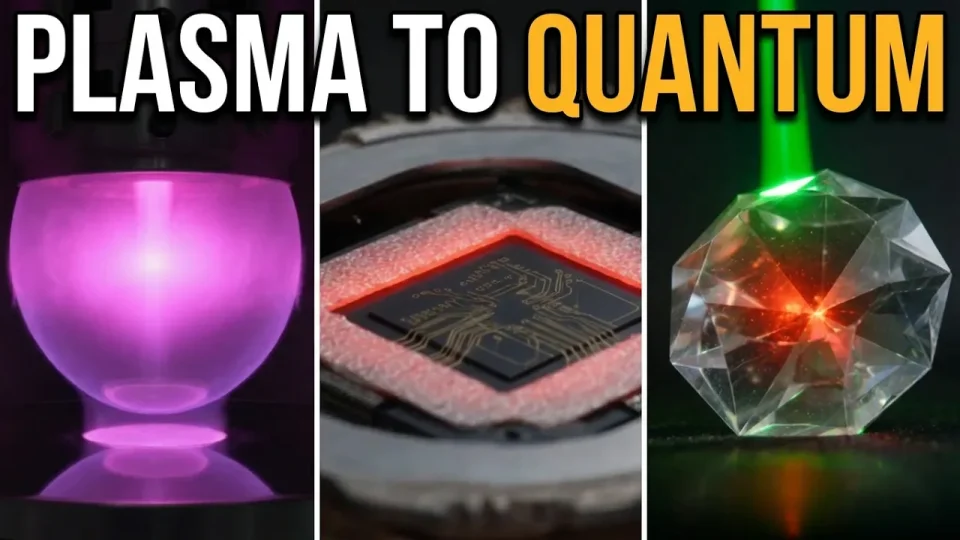
CVD; growing diamond from plasma: Chemical Vapor Deposition does not replicate the mantle. Instead, it grows diamond from gas. Methane and hydrogen are injected into a chamber and energized by microwave radiation, creating plasma at temperatures above 3,000°C. Inside the plasma, methane molecules are dissociated. Carbon atoms and hydrogen radicals rain down onto a heated diamond substrate. The hydrogen radicals are the critical element — they selectively attack and etch away any graphite that forms, leaving only sp3 diamond behind. The diamond lattice grows one atomic layer at a time. Over days to weeks, CVD produces single-crystal diamond wafers of extraordinary purity — impurity levels below one part per billion for quantum applications. CVD is growing at 11.29 percent annually, driven by semiconductor and quantum applications.
Diamond heat spreaders; cooling AI chips: Modern high-power semiconductor devices — gallium nitride power transistors, high-power laser diodes, RF amplifiers — generate heat fluxes that silicon substrates cannot dissipate fast enough. A CVD diamond heat spreader bonded beneath the chip moves heat orders of magnitude faster than any alternative, preventing thermal throttling and device failure. The global diamond heat spreader market reached $540 million in 2024, growing at 10.8 percent annually. Data center CPUs now experience heat fluxes of 150 W/cm² — up 50 percent since 2020 — making diamond thermal management increasingly critical for AI accelerator chips.
NV centers; room-temperature quantum computing: The nitrogen-vacancy (NV) center is a point defect in diamond where a nitrogen atom substitutes for carbon adjacent to a missing carbon (vacancy). This atomic-scale structure behaves like an artificial atom with a quantum spin — a qubit. Unlike superconducting qubits (which require cooling to 0.01 Kelvin in a dilution refrigerator) or trapped ions (4 Kelvin), diamond NV centers maintain quantum coherence at room temperature. This is because diamond’s lattice is predominantly carbon-12, which has zero nuclear spin — creating an extraordinarily magnetically quiet environment. In isotopically pure diamond, NV coherence times reach 1.8 seconds. NV centers are being deployed as quantum magnetometers detecting the magnetic field of individual neurons, for geological sensing, navigation, and quantum computing. Quantum-photonic diamond applications are growing at 31 percent CAGR. The US National Quantum Initiative authorized over $1.2 billion in quantum R&D through 2025, with significant allocations for diamond NV platforms.
Industrial applications; cutting, drilling, grinding: Over 80 percent of synthetic diamond production goes into cutting, grinding, and drilling. Polycrystalline diamond (PDC) drill bits drill kilometers into rock for oil, gas, and geothermal wells with lifetimes far beyond steel. Diamond grinding wheels machine hardened steel, ceramics, and composites that nothing else can finish economically. Diamond optical windows transmit from deep UV to far infrared, used in high-power CO₂ laser systems that would destroy any other window material. Diamond radiation detectors operate in particle accelerators and nuclear reactors where silicon fails instantly.
Diamond semiconductors; the ultimate frontier: Diamond’s 5.45 eV bandgap allows power transistors operating at much higher voltages, temperatures, and frequencies than silicon (1.1 eV) or even gallium nitride (3.4 eV). Diamond power devices could transform EV inverters, grid power electronics, and satellite systems. The diamond semiconductor market was valued at $2.1 billion in 2025, growing at 27.9 percent annually. The global synthetic diamond market is projected to reach $43.6 billion by 2034.
From methane plasma to the hardest material. From a pencil to a quantum computer. Diamond is not a luxury; it is a technology platform.
