Paper Title: Directly coupled photovoltaic alkaline electrolysis with low-cost carbon and stainless-steel electrodes: an exploratory assessment of single-axis solar tracking at sub-watt scale
Authors: Md. Farhan Imtiaz Chowdhury, Muhaiminul Islam, Md. Fahim Sadat Bari, Md. Shaib Hossain, Wasif Sadman Tanim
Corresponding Author: Md. Farhan Imtiaz Chowdhury (farhanimtiaz1999@gmail.com)/Bangladesh
Abstract
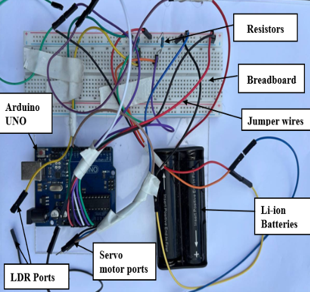
Hydrogen produced by wiring a solar array directly to an electrolyzer, with no battery or power electronics in between, is cheap to build, but little data exists on how such systems behave at very small scales. We built a 1.6 W-rated photovoltaic (PV) array and coupled it directly to a two-electrode alkaline cell (3.6 M NaOH). Two inexpensive electrode materials were tried: carbon rods recovered from spent dry cells and grade 304 stainless steel. Each was run at a fixed tilt with an Arduino-controlled single-axis tracker on one clear and one overcast day in Chattogram, Bangladesh, yielding eight configurations. Current and voltage were read every 5 minutes for 60 minutes. Charge and energy were obtained by trapezoidal integration. Hydrogen is reported only as a charge-derived equivalent from Faraday’s law, not as a measured volume. The cell received 1.8 to 24.7 mW, equivalent to 0.08 to 0.73 mL of hydrogen per hour. Mean cell voltages ranged from 7.9 to 16.1 V, indicating that ohmic and contact losses, not electrode kinetics, control the cell; voltage efficiency relative to the thermoneutral potential was only 9 to 19%. With carbon under a clear sky, tracking raised the energy delivered to the cell by 35%. However, the tracker used an estimated 180 to 720 J in the same hour, while the cell received at most 89 J, so tracking lost energy in every configuration we tested. A first-order break-even estimate puts the point where tracking starts to pay at about 0.9 to 2.0 W of delivered electrolysis power, some 35 to 80 times our load. Every configuration was run once, so the results are indicative only. The main finding is that active tracking is a net energy sink below about 1 W. We also identify the losses that limit the performance of directly coupled cells of this size.
