Why Is Electricity Transmitted at 500,000 Volts | The Physics of the Power Grid
Have you ever looked up at a high-voltage transmission tower and wondered why it carries 500,000 volts — when your wall outlet only delivers 120? Pumping half a million volts through open air seems dangerously excessive. But it is actually the single most important physics breakthrough that keeps the modern power grid alive.
Without extreme voltage, the cables connecting a power plant to your city would melt under their own heat before the electricity arrived. This video explains exactly why — using real physics, real engineering, and the mathematics that make it inevitable.
The complete physics and engineering:
P = V × I — current is the enemy: Power equals voltage times current. To deliver 1,000 megawatts to a city, engineers have a choice: high current at low voltage, or low current at high voltage. The resistance of a 500-kilometer aluminum transmission line is fixed at roughly 10 to 15 ohms. That sounds small — but the consequence of putting large current through that resistance is catastrophic.
I²R: Joule’s law and the square relationship: Power lost to heat equals current squared times resistance. This is the decisive equation. Double the current and losses quadruple. Halve the current and losses drop to one quarter. Doubling transmission voltage from 250 kV to 500 kV halves the current, cutting I²R losses by 75 percent. Stepping to 765 kV instead reduces losses by 89 percent compared to 250 kV. Every volt upward cuts waste exponentially — because of the square law. At 10,000 volts instead of 500,000, the current needed to carry 1,000 megawatts would be 100,000 amperes — requiring conductors several meters thick, or the line would simply melt. High voltage is not a design preference. It is the only physically possible answer.
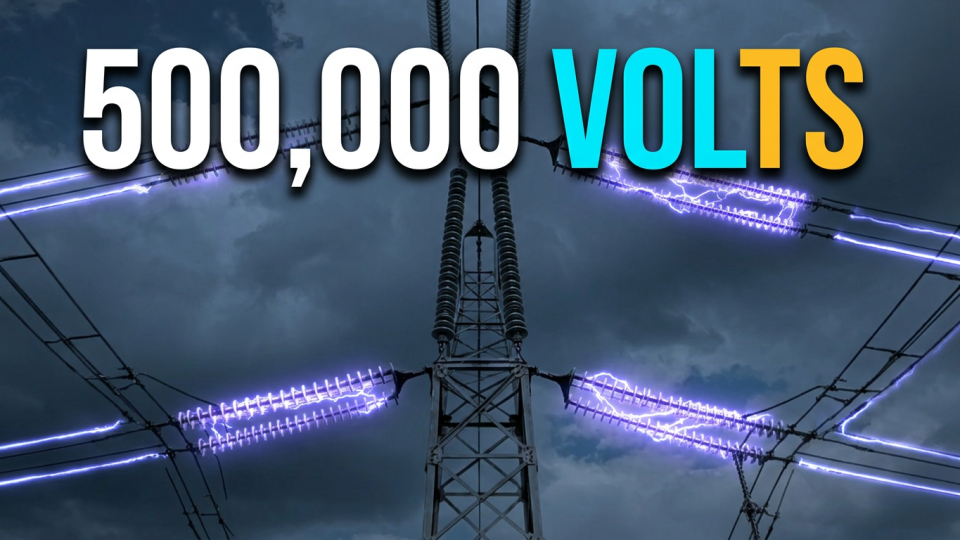
Corona discharge, the price of extreme voltage: High voltage creates a new problem: when the electric field around a conductor exceeds about 30 kilovolts per centimeter, the surrounding air ionizes—producing a violet glow, a hissing sound, ozone, and continuous energy loss. This is corona discharge. In fair weather, corona loss on a 765 kV bundled line is about 1.87 kilowatts per kilometer. In bad weather — rain, ice, contamination — it can exceed 84 kilowatts per kilometer. The distinctive hum you hear under power lines is the acoustic signature of corona — the air itself being torn apart by the electric field. Engineers manage corona with bundled conductors (two to six sub-conductors per phase instead of one, spreading the electric field across a larger effective radius) and corona rings—smooth metal toroids at cable terminations that redistribute the field evenly.
Transformers, the device that makes it possible: At the power plant, a generator step-up transformer takes the generator output (typically 15 to 25 kV) and steps it up to 500 kV using Faraday’s law of induction. A transformer’s voltage ratio equals its turns ratio — a 1:20 turns ratio steps 25 kV up to 500 kV while stepping the current down by the same factor. A single large 500 kV substation transformer can weigh over 400 tonnes, handle 1,000 megawatts, and contain a core of thousands of laminated grain-oriented silicon steel sheets immersed in insulating oil. The global power transformer market was worth $30.38 billion in 2025.
The complete voltage journey, five transformer stages: Power is generated at roughly 25 kV, stepped up to 500 kV at the generator transformer, transmitted hundreds of kilometers, stepped down to 115 kV at the receiving substation, stepped down again to 4–35 kV at distribution substations, and finally reduced to 120 or 230 volts at your wall socket by neighborhood pole-top or pad-mounted transformers. Five voltage transformations. Five transformer stages. One continuous journey. The 80 million kilometers of power lines worldwide represent one of the most complex engineering systems ever built.
HVDC, when DC beats AC: For distances beyond roughly 600 kilometers, High-Voltage Direct Current (HVDC) becomes advantageous. AC transmission loses energy to reactive power flow and requires grid synchronization. DC has no reactive losses and can connect asynchronous grids. Modern HVDC lines operate at ±800 kV and can carry up to 12 gigawatts per bipole link. China invested approximately $40 billion in high-voltage transmission in 2023 alone, now operates 38 ultra-high-voltage lines, and commissioned a 1,200 kV UHVDC transformer capable of transmitting power over 3,000 kilometres.
🌱 The renewable energy future demands more EHV, not less: Offshore wind farms require long HVDC submarine cables. Desert solar must reach industrial cities thousands of kilometres away. Every megawatt of renewable energy added to the grid makes long-distance EHV transmission more critical. The towers are not going away. They are multiplying.
The next time you look up at a transmission tower — you are seeing the only answer physics allows to the problem of moving enormous energy across enormous distances without losing it all to heat.
