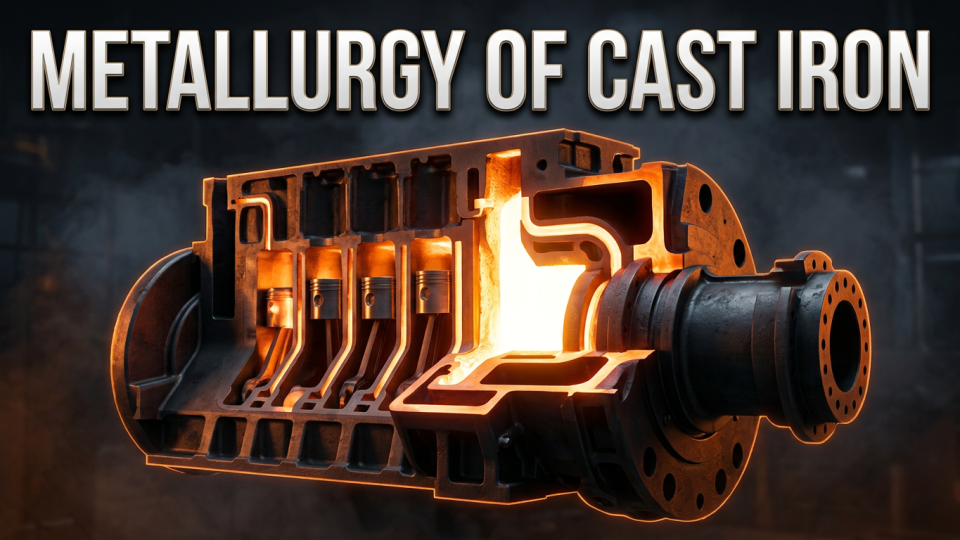
The Secret Metallurgy of Cast Iron | How It Powers Modern Heavy Industry
Inside a wind turbine hub carrying 200 tonnes of rotor load. Inside a CNC lathe bed holding position to within one micrometer. Inside a diesel engine cylinder surviving millions of combustion cycles. The material making all three possible is not steel — it is cast iron. And its secret is in its chemistry.
Cast iron contains more carbon than steel, typically 2.5 to 4 percent, and depending on how that carbon forms during solidification, it creates three completely different engineering materials from the same liquid. The metallurgist’s choice of microstructure determines everything.
The complete metallurgy:
Carbon content and the three microstructures: Steel contains less than 2 percent carbon. Cast iron contains 2.5 to 4 percent carbon plus 1 to 3 percent silicon. That extra carbon completely changes what happens during solidification. During cooling, the carbon has a choice: bond chemically with iron to form cementite — or precipitate as pure graphite. Which path it takes depends on cooling rate, silicon content, and the presence of inoculants added to the melt at the last moment before pouring. The result is three fundamentally different engineering materials that start from the same liquid.
Grey cast iron, graphite flakes that absorb vibration and self-lubricate: Grey iron contains graphite in the form of microscopic flakes distributed randomly through the iron matrix — like tiny leaves of pure carbon embedded in metal, the same element as a pencil. These flakes absorb and dissipate vibration energy 10 to 20 times more effectively than steel, aluminum, or any fabricated structure of equivalent geometry. A CNC lathe bed that vibrates transmits chatter to the cutting tool, destroying precision. A grey iron bed that dampens vibration holds micrometer tolerances. Grey iron’s graphite flakes also serve a unique second purpose: self-lubrication. As a sliding surface wears, graphite releases from the matrix and forms a dry lubricant film at the contact zone. This is why grey iron has been used for engine cylinder bores and piston rings for more than a century — no other structural metal lubricates itself naturally.
Ductile iron, one teaspoon of magnesium changes everything: Adding just 0.05 percent magnesium to molten grey iron — approximately a teaspoon per tonne — transforms the entire microstructure. Magnesium prevents graphite from forming flakes. Instead, carbon precipitates as perfect spheres called nodules. Think of it as changing thousands of tiny knives in the metal into thousands of tiny ball bearings. In grey iron, flake graphite creates sharp stress concentrations — cracks propagate easily along the flake edges. In ductile iron, spheroidal nodules deflect and stop crack propagation. The result: ductile iron achieves tensile strengths of 400 to 900 MPa — comparable to many grades of steel — while retaining cast iron’s exceptional castability. Wind turbine hubs weighing 20 to 30 tonnes are cast as a single piece in ductile iron.
White cast iron, when carbon stays chemically bonded: When cast iron cools too rapidly or silicon content is low, carbon bonds chemically with iron to form cementite (Fe₃C) rather than precipitating as graphite. The result is white cast iron — named for its bright white crystalline fracture surface. It achieves hardness of 400 to 700 Vickers — comparable to some tool steels — but is very brittle. Its application is wherever abrasion resistance matters above all else: mining mill liners, crusher wear parts, and slurry pump components.
The foundry process, induction furnace, inoculation, green sand molding: Modern cast iron melts in an electric induction furnace — essentially a microwave oven for metal — where a high-frequency electromagnetic coil generates heat directly inside the metal at 1,400 to 1,500°C. The charge of scrap steel, pig iron, and alloying elements melts in approximately 45 minutes. At the critical moment before pouring, inoculants — typically ferrosilicon alloys containing calcium, barium, or strontium — are added to create microscopic nucleation sites that control graphite morphology. Most castings use green sand molds — sand, clay, and water — where the metal solidifies from the outside inward. Cooling rate is the most critical variable: thick sections cool slowly, producing grey iron; thin sections risk white iron formation. Foundries place metal chill inserts at specific locations to control local cooling rates.
Why industry cannot replace cast iron with steel: Welded steel structures do not provide equivalent vibration damping at equivalent weight or cost. Steel cannot self-lubricate. Steel castings shrink more during solidification, creating voids in complex geometries. Cast iron flows into intricate, thick-walled shapes with a fluidity that steel cannot match at a comparable cost. The global iron casting market was worth $117 billion in 2024 and is projected to reach $172 billion by 2030. Cast iron is not legacy technology. It is optimized technology.
Industrial case studies:
CNC machine tool beds: Grey iron damps cutting vibration 10–20× better than steel, enabling micrometer-precision machining. Around 48% of machine tool bases worldwide use grey cast iron.
Wind turbine hubs: A 5 MW turbine hub weighs 20–30 tonnes, cast as a single ductile iron piece. Renewable energy casting demand increased 18% in 2025.
Diesel engine cylinder blocks: Vibration damping reduces engine noise. Graphite self-lubricates the bore. The material machines cleanly and economically at volume.
Industrial forging presses: Grey iron press beds absorb the vibration of 10,000-tonne hydraulic presses, protecting precision tooling without additional isolation systems.
Cast iron is not legacy technology. It is optimized technology — hidden in plain sight at the foundation of modern heavy industry.
