Paper Title: Comparative evaluation of milling machine tooling fixtures using finite geometry and finite element methods
Authors: Stephen Takim, Ayantunji S.A
Corresponding Author: Stephen Takim (xamskye@gmail.com)/Nigeria
Abstract
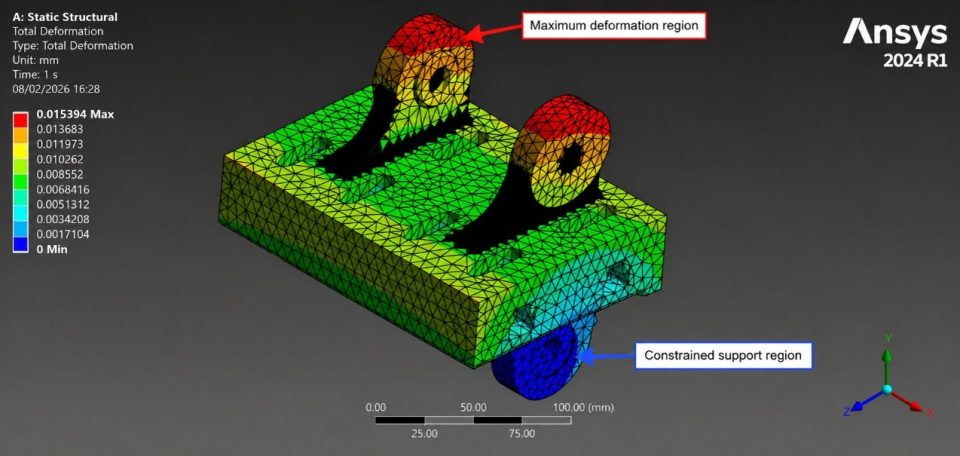
Fixture layout directly affects workpiece stability during milling, but checking several possible locator arrangements with finite element analysis can be time-consuming, especially at the initial design stage. This study examines a milling machine angle plate fixture using a two-stage Finite Geometry (FG) and Finite Element Analysis (FEA) procedure based on the 3–2–1 locating principle. Three locator configurations were developed from the fixture geometry and first assessed using finite geometry. The Effective Support Area and Kinematic Stability Index (KSI) were used to assess the geometric stability of each arrangement, with MATLAB used to carry out the required geometric calculations. The KSI values obtained for Configurations 1, 2, and 3 were 0.01214, 0.01033, and 0.00772, respectively. Configuration 3 was consequently selected for structural assessment. The selected configuration was then analyzed in ANSYS Mechanical under a 10 kN distributed machining load. A maximum von Mises stress of 48.322 MPa and a maximum deformation of 0.015394 mm were obtained. The results show that the geometric assessment provided a means of screening the three locator arrangements before the more detailed finite element analysis was carried out. The study therefore demonstrates the use of FG as a preliminary assessment stage, followed by FEA for structural verification of the selected fixture configuration.
