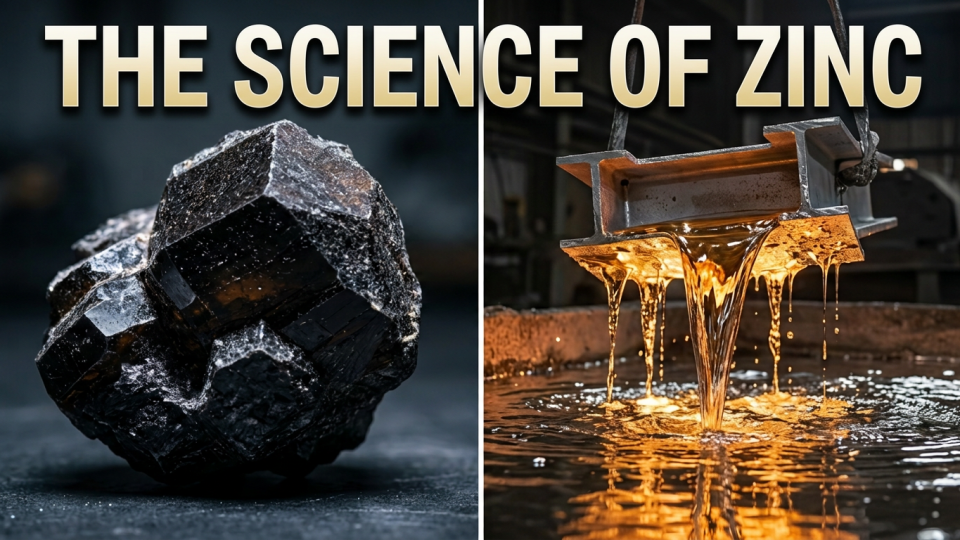
The Science of Zinc | From Raw Ore to Essential Global Applications
What if one of the metals protecting the modern world is something you almost never notice? Inside every bridge, skyscraper, and car, a metal is working invisibly to prevent destruction. Without it, steel infrastructure would corrode within years. This is zinc. And it starts as an ordinary-looking black rock deep inside the Earth.
Zinc is the fourth most consumed metal on Earth — a $42 billion global market producing over 13 million tonnes per year. It protects the steel in bridges and wind turbines, forms the housing of your car door handle, and exists inside every cell of your body. Yet almost nobody knows where it comes from or how it is made.
The complete journey:
The ore, sphalerite ZnS: The primary zinc ore is sphalerite — zinc sulfide (ZnS) — containing 50 to 65 percent zinc by weight. It forms in hydrothermal mineral deposits alongside lead, silver, and copper and looks unremarkable: dark, metallic, sometimes with a resinous lustre. It is found in Australia, China, Peru, the USA, and India. Open-pit and underground mines extract ore containing as little as 3 to 10 percent zinc — meaning over 90 percent of what is mined is waste rock. Giant haul trucks carry 400-tonne loads of blasted ore from the pit floor to the primary crusher.
From rock to concentrate, crushing, grinding, and froth flotation: The ore is crushed to gravel size, then ground in rotating ball mills, enormous steel drums filled with steel balls, to particles finer than table salt, forming a slurry the consistency of thick paint. The next step is froth flotation: specific chemicals make sphalerite particles water-repellent while leaving other minerals water-loving. Air bubbles blown through the slurry carry the sphalerite to the surface while everything else sinks. In one step, the zinc content rises from 3 percent to 50–55 percent. This is the zinc concentrate.
The furnace: roasting ZnS to ZnO at 900°C: The zinc sulfide concentrate enters a fluidized-bed roasting furnace at approximately 900°C. The sulfur reacts with oxygen and exits as sulfur dioxide gas. What remains is zinc oxide,also called calcine — a pale yellowish powder containing the zinc now stripped of its sulfur. The SO₂ is captured and converted to sulfuric acid — a valuable co-product used in fertilizers and chemical manufacturing. The environmental engineering around a zinc smelter is as sophisticated as the metallurgy itself.
The chemical factory: leaching, purification, and electrowinning (RLE process): More than 90 percent of global zinc production uses the Roasting–Leaching–Electrowinning (RLE) route. The zinc oxide calcine is dissolved in dilute sulfuric acid — like dissolving sugar in water — forming a zinc sulfate solution. The solution is purified through successive precipitation stages to remove iron, copper, cadmium, and other contaminants. The purified solution then enters the electrowinning tankhouse: rows of electrolysis cells where electric current — approximately 3,900 kilowatt-hours per tonne of zinc — causes pure zinc to deposit on aluminum cathode sheets over 24 to 48 hours.
The metal emerges — 99.995% pure: After 24 to 48 hours, mechanical cathode stripping machines remove zinc deposit sheets from the aluminum cathodes. Each sheet contains 50 to 70 kilograms of zinc at 99.995 percent purity — Special High Grade (SHG) zinc. The sheets are melted at just 419°C and cast into ingots, jumbo blocks, or slabs for global distribution to galvanizers, die casters, and alloy producers.
The invisible shield — hot-dip galvanizing: Over half of all global zinc consumption is associated with galvanizing steel. Steel is cleaned, fluxed, and lowered into a bath of molten zinc at 445 to 455°C. The zinc reacts with the steel surface, forming a series of zinc-iron alloy layers bonded at the atomic level, then a pure zinc outer layer. The protection works two ways simultaneously: a physical barrier blocking moisture and oxygen, and sacrificial protection — because zinc is electrochemically more reactive than iron (Zn: -0.76V vs SHE; Fe: -0.44V), when a scratch exposes the steel, zinc corrodes first, protecting the steel even where the coating is broken.
Beyond galvanizing: die casting, batteries, and energy storage: Zinc alloys melt at just 420°C, making them ideal for high-speed precision die casting. Zinc die castings are in car door handles, windshield-wiper mechanisms, locks, zippers, and power tool housings. Zinc-air batteries generate electricity through the reaction of zinc with oxygen from the surrounding air — already used in hearing aids and being developed for grid-scale energy storage with energy density competitive with lithium-ion and no thermal runaway risk.
Zinc and the human body: The human body contains approximately 2 to 3 grams of zinc distributed across every organ and tissue. Zinc is required for the function of over 300 enzymes. It is a structural element in zinc finger proteins that regulate gene expression and DNA repair. It plays roles in immune function, normal growth, and wound healing. Foods rich in zinc include shellfish, red meat, legumes, and seeds. Zinc depletion in soils represents a significant global agricultural and nutrition challenge.
The future: Approximately 30 percent of global zinc production already comes from secondary (recycled) zinc. Zinc batteries are emerging as alternatives to lithium for grid-scale storage. Galvanized steel for wind turbine towers, solar mounting systems, and renewable energy infrastructure represents one of the fastest-growing application markets. The global zinc market is projected to reach $61 billion by 2036 at a CAGR of 3.48 percent.
Zinc is not simply another metal. It is a hidden enabler of modern civilization — extracted from rock, transformed through chemistry and electricity, and ultimately used to make infrastructure last longer, technology function, and modern life possible.
