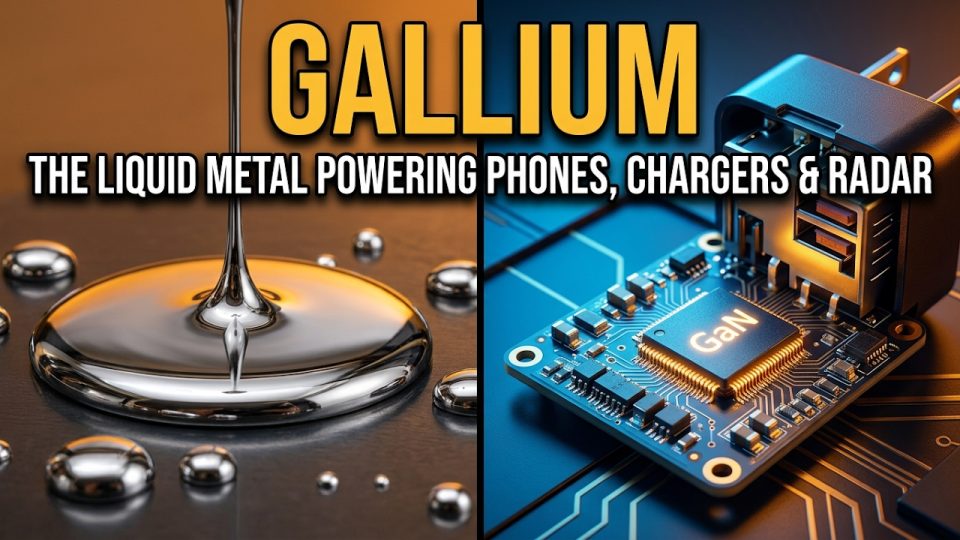
Gallium: The Liquid Metal Powering Phones, Chargers, and Radar
Gallium (atomic number 31) is a soft, silvery metal that melts at just 29.8 °C, so a solid piece liquefies in a warm hand. Predicted by Mendeleev as “eka-aluminum” and discovered in 1875, it occurs in no mine of its own. It is recovered as a trace byproduct, mainly from refining bauxite into alumina, where the ore averages roughly 50 ppm gallium, and to a lesser extent from zinc-processing residues.
In the Bayer process, gallium builds up in the circulating caustic liquor. Producers concentrate it with ion-exchange resins or solvent extraction. Some resins capture about 96% of the gallium while mostly ignoring aluminum. Electrolysis then yields crude metal of about 99.99% purity, and fractional crystallization raises this to 99.99999% (7N) for semiconductor use.
Most gallium is consumed as compounds. Gallium nitride (GaN), a wide-bandgap semiconductor, withstands far stronger electric fields than silicon, enabling compact chargers and power supplies, and it is entering EV and data-center power systems. Gallium arsenide (GaAs) amplifies radio signals in smartphones and powers satellite solar cells and radar. GaN LEDs earned the 2014 Nobel Prize in Physics. Galinstan alloys serve as liquid-metal heat conductors, and gallium oxide is an emerging candidate for high-voltage power electronics.
Supply is concentrated: China produces about 99% of primary low-purity gallium, and the United States relies entirely on imports. Few countries have refining capacity, so prices and availability can shift quickly with policy. Export licensing since 2023 has made gallium a strategic material, while recycling of end-of-life products remains minimal.
