Paper Title: Predicting the direction of volatility in the Vietnamese stock market: A machine learning approach integrating macroeconomic uncertainty, financial stress, and petrodollar dynamics
Authors: Trinh Vo Thi Ngoc, Tuyen Le Nam, Nguyen Anh Phong, Tam Phan Huy, Quang Thuy Chu
Corresponding Author: Trinh Vo Thi Ngoc (vtntrinh@uel.edu.vn)/Vietnam
Abstract
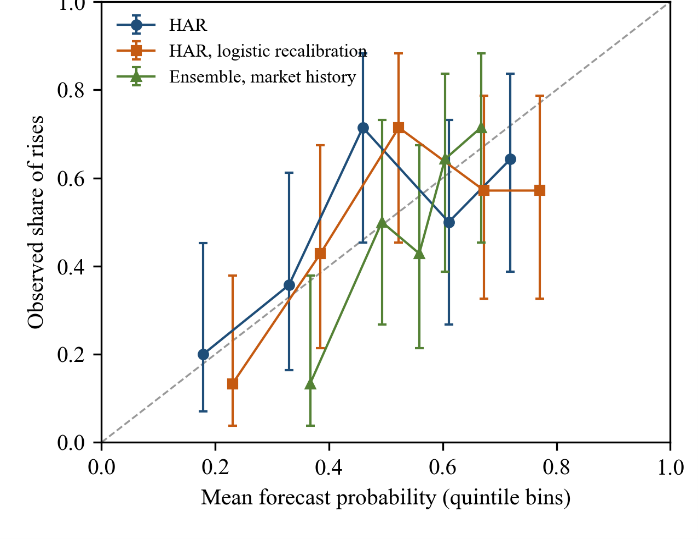
This research forecasts the direction of next-month realized volatility in the Vietnamese stock market, a newly upgraded emerging market, and tests whether global policy uncertainty, geopolitical risk, a domestic financial stress index, and dollar-oil price changes add predictive content beyond market history. A walk-forward design on monthly data from 2015 to 2025 produces seventy-one out-of-sample forecasts for 2020 to 2025. Five machine learning classifiers and their average are compared with heterogeneous autoregressive (HAR), generalized autoregressive conditional heteroskedasticity mixed-data sampling (GARCH-MIDAS), and rank-based benchmarks. About two-thirds of months are classified correctly, and the best ensemble reaches an area under the curve of 0.726. A rule that only ranks current volatility in its own history reaches 0.713, so most of this ability reflects reversion from unusually high or low levels. No classifier beats the HAR benchmark. Adding uncertainty and stress raises (worsens) the Brier score by 0.002, and adding all four blocks by 0.007. When predictable reversion is removed from the target, no information set beats a constant forecast. The in-sample contribution of the blocks is significant under a Gaussian likelihood-ratio test but not under a test robust to fat tails. A timing rule based on market history raises the Sharpe ratio in point estimates, but only a specification identified after the fact is significant. In this market and sample, a lean model of market history is the more reliable basis for directional risk signals.
