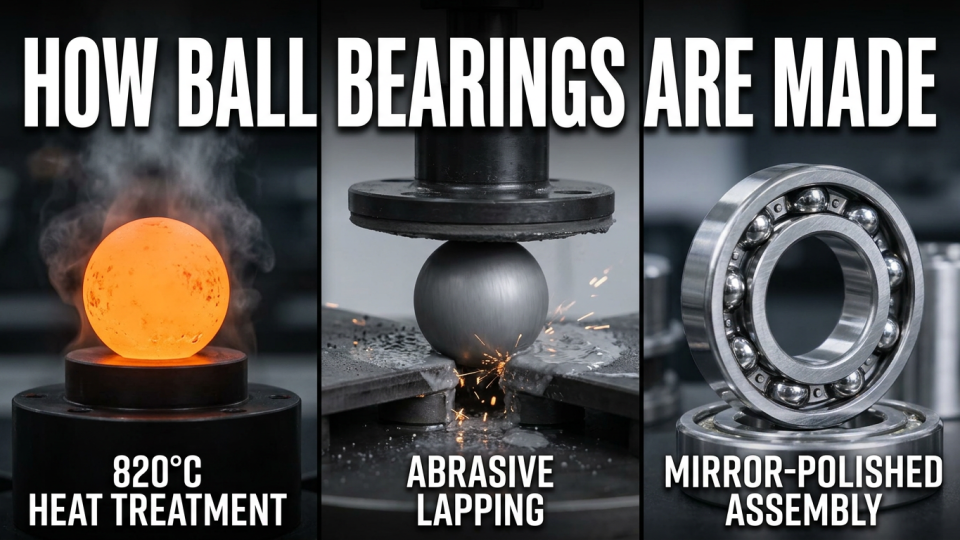
How Ball Bearings Are Made | The Precision Engineering Powering Modern Machines
Inside a jet engine turbine, a wind turbine, and every electric vehicle motor, one component is one most people have never thought about. A steel sphere so precisely round that its deviation from a perfect circle is less than one thousandth of a millimeter. This is how it is made, and it starts with a coil of wire.
Ball bearings are among the most precisely manufactured objects in industrial history. Every car contains 100–150 of them. Every jet engine depends on them. Every wind turbine runs on them. The global market was worth $45 billion in 2024. Yet almost nobody knows what it takes to make one.
The complete manufacturing process:
Cold heading: from wire to ball blank in under a tenth of a second: Every bearing ball begins as a spool of SAE 52100 high-carbon chromium steel wire, an alloy containing precisely controlled amounts of carbon (0.95–1.10%), chromium (1.30–1.60%), manganese, and silicon, chosen because it can be hardened to 62–66 HRC without becoming brittle. A cold heading machine feeds the wire through a carbide die that cuts it to length in a fraction of a second, then a punch drives the slug between two curved die faces under enormous pressure — forming a rough sphere called a ball blank in under a tenth of a second. The blank has a visible seam line called flash running around its equator. It looks nothing like a bearing ball.
Flash grinding and soft grinding: rough sanding before the fine work: The ball blank is loaded between two grooved cast iron plates, one stationary, one rotating, and rolls randomly in the grooves under pressure, slowly abrading away the flash seam. Think of it as rough sanding before the fine work begins. Multiple passes with progressively finer plates bring the blank closer to its target shape. The result is a soft-ground ball, rounder, seam-free, but still nowhere near bearing tolerances.
Heat treatment: a city of atoms reorganized by heat: The soft-ground balls enter a continuous belt furnace heated to above 820°C. At this temperature, the iron crystal structure rearranges itself from ferrite and pearlite into austenite — a city of atoms reorganized in preparation for quenching. The balls are immediately plunged into cold quench oil. The rapid cooling traps the steel in its high-temperature crystal arrangement, creating martensite — extraordinarily hard and wear-resistant. The balls then undergo tempering — gentle reheating to reduce brittleness while retaining hardness of 62–66 on the Rockwell C scale.
Hard grinding and lapping: precision emerges from randomness: After heat treatment, hard grinding between abrasive plates removes microscopic material, just fractions of a micrometer per cycle, while continuous measurement guides each pass. Then comes lapping: the most extraordinary precision process in bearing manufacture. The balls tumble between cast iron lapping plates with an ultra-fine abrasive compound finer than talcum powder for many hours. Because the ball rolls in a completely random, constantly changing path — never the same direction twice- high spots are uniformly abraded away from every part of the surface simultaneously. Precision emerges from randomness. The final G5-grade ball achieves a surface finish of Ra 0.01 micrometers, one hundredth of a micrometer from perfect, and diameter variation of less than 5 microinches (0.127 micrometers).
Race manufacturing: cutting the groove that carries the ball: On a parallel production line, bearing rings called races are turned from SAE 52100 steel tube on CNC lathes. The critical raceway groove, the curved channel where the balls roll- is cut to a profile that must match the ball’s curvature to within micrometers. The races undergo the same heat treatment sequence as the balls, then precision grinding of the raceways with a diamond-dressed grinding wheel.
Matching, assembly, cage, and grease: Before assembly, inner and outer rings are individually measured. Balls of the correct diameter are selected to produce the specified internal clearance — even a 0.001mm mismatch would produce noise, vibration, and premature failure. A pressed steel, brass, or polymer cage holds the balls at equal spacing around the raceway to prevent them clustering under centrifugal force. Precisely measured grease is injected before sealing.
100% inspection: every unit, not sampling: Every finished bearing undergoes laser micrometer measurement of radial runout to less than one micrometer, vibration analysis to detect invisible surface defects, and automated accept-reject sorting. Not one bearing ships without passing every test.
Grading and applications: A G100 bearing has diameter variation up to 100 microinches, adequate for conveyors and fans. A G5 bearing has variation under 5 microinches, used in jet engine turbines, gyroscopes, and precision machine tools. G5 is 20 times more precise than G100 and requires hundreds of additional lapping hours. Electric vehicle motors spin at up to 20,000 RPM. Offshore wind turbine main shaft bearings carry hundreds of tonnes continuously for 25 years.
From a wire coil to a perfect steel sphere, ball bearings are one of engineering’s most underappreciated achievements. Everything that moves, moves on bearings.
