How Is Tungsten Made? The Extreme Process Behind the World’s Hardest Metal
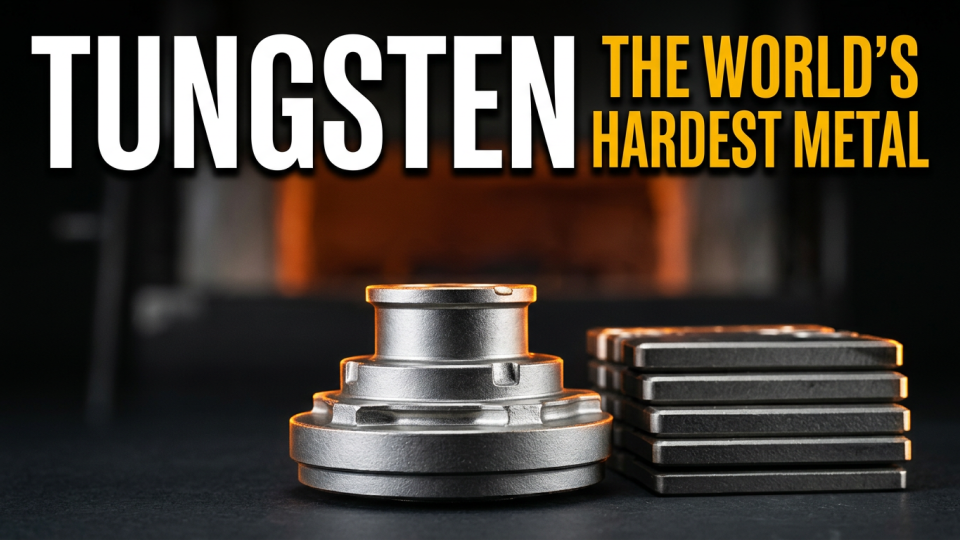
This is tungsten. It melts at 3,422 degrees Celsius, the highest melting point of any metal on Earth. You cannot melt it in a conventional furnace. You cannot cast it in a mould. A standard steel furnace would vaporize long before tungsten even begins to soften. So how does industry transform a black mineral rock into one of the strongest, most heat-resistant materials ever discovered?
China controls 83 percent of global tungsten supply, and in February 2025, imposed export restrictions on APT, tungsten powder, and carbide. Within one year, the APT benchmark price multiplied five times. The global tungsten market is valued at $5.5 billion in 2026, growing at 7.8 percent annually.
The complete process, from ore to extreme applications:
The minerals and geology: Tungsten occurs in just two main ore minerals — wolframite (iron-manganese tungstate) and scheelite (calcium tungstate). Its crustal abundance is just 1.5 parts per million. China’s Jiangxi and Hunan provinces hold approximately 52 percent of known global reserves of 4.6 million tonnes. Global mine production reached approximately 85,000 tonnes in 2025. Vietnam, Russia, Kazakhstan, and Canada supply most of the remaining 17 percent outside China.
Mining and ore grades: Tungsten mines operate as open-pit and underground operations. Commercial ore grades typically range from 0.2 to 1.5 percent WO₃ — meaning 100 to 750 kilograms of tungsten oxide must be recovered from each tonne of ore processed. The ore is drilled, blasted, loaded, and crushed at the mine site before concentration.
Gravity separation: The crushed ore is ground in ball mills and processed through gravity concentration. Wolframite has a specific gravity of 7.5 and scheelite 6.1 — far denser than silicate gangue. Shaking tables, jigs, and spiral concentrators exploit this density contrast: heavy tungsten minerals settle into riffle zones while lighter waste rock washes away.
Magnetic separation: Wolframite is strongly magnetic, allowing high-intensity magnetic separators to pull it from the pre-concentrated gravity product. Scheelite, being non-magnetic, is processed by froth flotation. Through successive gravity, magnetic, and flotation stages, the final tungsten concentrate typically reaches 65 percent WO₃ or higher — the commercial grade shipped to chemical processing facilities.
Caustic leaching and APT crystallization: The tungsten concentrate cannot be smelted directly. It must be chemically digested in an autoclave at 150–200°C with sodium hydroxide (caustic soda) under pressure — dissolving the tungsten as sodium tungstate solution. This solution is purified through solvent extraction and ion exchange to remove iron, manganese, phosphorus, arsenic, and silica. The purified solution is then treated with ammonium to precipitate ammonium paratungstate — APT — as brilliant white crystals. APT is the universal precursor for all tungsten products worldwide and the global benchmark for tungsten pricing. Every rocket nozzle, fusion reactor component, and carbide cutting tool on Earth passed through this white crystal.
Calcination and hydrogen reduction: APT is calcined in a rotary kiln at 500–800°C, decomposing the ammonium groups to produce tungsten trioxide (WO₃) — a bright yellow powder. The WO₃ is then pushed through a long hydrogen atmosphere tube furnace at 800–1,100°C. The reaction: WO₃ + 3H₂ → W + 3H₂O. Hydrogen strips the oxygen atom by atom, leaving ultra-fine elemental tungsten powder at particle sizes of 0.6 to 22 micrometers.
Powder metallurgy, the no-melt method: Because tungsten’s 3,422°C melting point destroys any industrial containment vessel, conventional casting is impossible. Instead, the powder is compacted under high hydraulic pressure into a dense green compact, then sintered in a hydrogen atmosphere furnace at 2,000–2,400°C — still below the melting point. At this temperature, tungsten particles bond through solid-state diffusion. The compact shrinks 15–20 percent and achieves 93–98 percent of theoretical density. The result is a tungsten billet produced without the metal ever becoming liquid.
Tungsten carbide, 60 percent of all tungsten: The dominant application: tungsten powder is mixed with carbon and sintered with a cobalt binder to form WC-Co cemented carbide — one of the hardest materials on Earth, approaching diamond in hardness. Tungsten carbide machines steel, drills rock, grinds concrete, and cuts composites at speeds no other material can match. Every metal component you own was likely shaped by a tungsten carbide tool.
Aerospace and defence: Kinetic energy penetrators use dense tungsten alloy rods for armor penetration. Rocket engine nozzles and hypersonic vehicle thermal protection use tungsten because no other material survives the heat flux. Military demand surged in 2025 and 2026 as geopolitical tensions intensified, driving the APT price to 12-year highs in mid-2025.
Fusion energy, ITER divertor plates: The most extreme tungsten application: ITER uses tungsten monoblocks as divertor plates facing the plasma at steady-state heat fluxes of 10 to 20 megawatts per square meter — more intense than the surface of the Sun. Tungsten’s low sputtering yield, high thermal conductivity, and negligible tritium retention make it the only viable plasma-facing material.
Electronics and semiconductors: Tungsten fills the microscopic contact plugs and interconnects between transistor layers in advanced chips — deposited by chemical vapor deposition where nothing else withstands the deposition temperatures. X-ray tube anodes use tungsten because it absorbs electron bombardment heat that would destroy any other metal. The AI and 5G chip boom is driving new tungsten demand in semiconductor manufacturing.
3,422°C. Cannot be melted. Cannot be cast. Made by powder metallurgy. Shapes every metal component, powers rocket nozzles, faces fusion plasma — and China controls 83 percent of the supply.
