The Metal That Defies the Heat | How Molybdenum Is Made
How can a jet engine survive temperatures hot enough to melt ordinary steel? Part of the answer begins with a strange black mineral pulled from open-pit mines in Chile and Colorado. It looks like graphite. It feels almost greasy. And after chemistry, hydrogen, and engineering transform it, it becomes part of the technology that survives some of the most extreme conditions humans have ever created.
This is the complete story of molybdenum, from the mine to the metal, told for everyone.
The complete science:
The ore, molybdenite MoS₂: Most of the world’s molybdenum comes from enormous open-pit copper mines where molybdenite is recovered as a valuable byproduct. The ore contains less than 0.1 percent molybdenite by weight; everything else is waste rock. Giant haul trucks carry 400 tonnes per load from the blast face to the primary crusher. China produces over 110,000 metric tonnes per year. Peru, Chile, and the USA follow. Global production increased 6 percent in 2024. The market was worth approximately $5.98 billion in 2025 and is projected to reach $11.20 billion by 2032.
The crush, grinding mills, and the separation problem: The primary crusher reduces boulders to fist-sized fragments. Ball mills — enormous steel drums filled with steel balls — grind those fragments to a fine slurry the consistency of thick paint. Inside that slurry, molybdenite particles are mixed with copper minerals, iron minerals, and silica. You cannot see the difference. You cannot filter it. You cannot use a magnet. The solution uses soap and bubbles.
The float, froth flotation: Specific chemicals added to the slurry make molybdenite particles water-repellent while leaving copper and waste minerals water-loving. Air is bubbled through the mixture. The water-repellent molybdenite particles attach to the bubbles and ride them to the surface. The copper stays behind. Multiple flotation stages follow, first concentrating both copper and molybdenite, then selectively separating molybdenite from copper. What emerges is molybdenum concentrate, a dark grey powder containing 85 to 90 percent molybdenite. From 0.1 percent to over 85 percent, in one building.
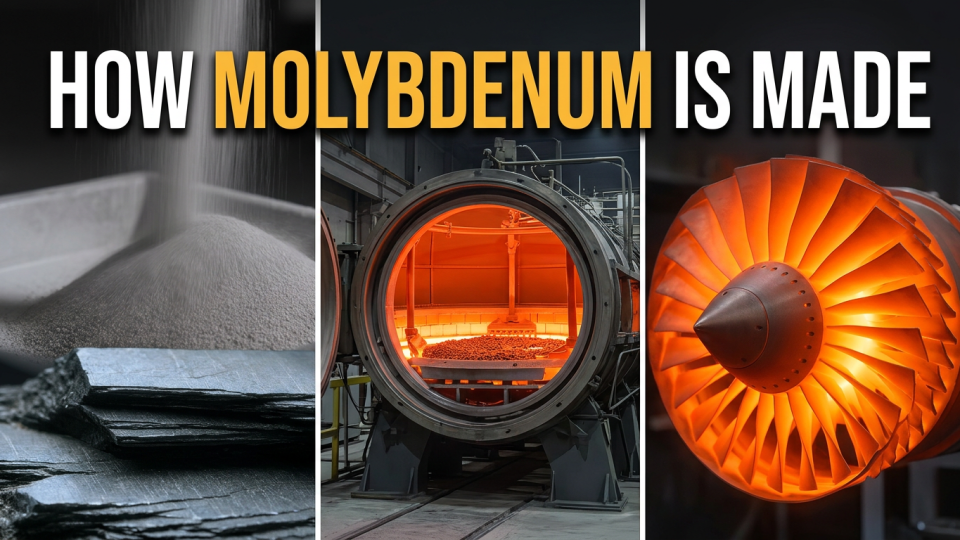
The furnace: roasting MoS₂ to MoO₃: The concentrate is heated in air at 500 to 650 degrees Celsius in a multiple-hearth roasting furnace. The sulfur reacts with oxygen and leaves as sulfur dioxide gas. What remains is technical-grade molybdenum trioxide — a pale blue-green powder containing at least 57 percent molybdenum and less than 0.1 percent sulfur. The color change from dark black to pale blue-green is the visible proof the chemistry worked. The SO₂ released is captured in scrubbing towers for conversion to sulfuric acid.
The reduction: hydrogen strips the oxygen: Molybdenum trioxide is not yet metal. To become pure molybdenum, oxygen must be removed. The industrial method runs hydrogen gas through the oxide at 900 to 1,000 degrees Celsius. Think of hydrogen as a chemical sponge — it bonds with oxygen atoms and pulls them away from the molybdenum. Water vapour exits the furnace. Pure molybdenum metal powder remains. Fine, silvery-grey, and extraordinarily pure.
From powder to solid metal: powder metallurgy: Molybdenum’s melting point of 2,623 degrees Celsius — the fourth highest of any element on Earth, makes conventional casting impossible. The powder is pressed under over 200 megapascals into a compact called a green body, like pressing a giant metal tablet under a hydraulic press. The compact then enters a sintering furnace heated to 1,800 to 2,000 degrees Celsius in a controlled hydrogen atmosphere. The particles bond without fully melting — like snowflakes pressing together to form ice. The compact shrinks slightly and densifies into solid molybdenum metal.
Why molybdenum handles heat: Molybdenum retains strength at elevated temperatures far better than most metals — which soften long before they melt. While ordinary steel begins to soften above 600 degrees Celsius, molybdenum maintains structural integrity at temperatures where other metals have long since failed.
The limits: oxidation: Pure molybdenum has one critical weakness. Above approximately 600 degrees Celsius in air, it reacts rapidly with oxygen to form molybdenum trioxide, the same compound made in the roasting furnace. This oxide is volatile and can consume the metal surface. Pure molybdenum is rarely used alone in high-temperature air environments. Instead, engineers use molybdenum-containing alloys and superalloys, where molybdenum contributes its heat tolerance while other elements, chromium, aluminium, cobalt, provide oxidation resistance. Together the alloy achieves what no single element can.
Aerospace and beyond: Molybdenum-containing nickel superalloys are used in jet engine turbine sections where temperatures exceed 1,500 degrees Celsius. Industrial furnace heating elements operate at over 1,800 degrees Celsius. Petroleum refinery catalysts use molybdenum compounds for hydrodesulfurization. Medical X-ray tubes, semiconductor manufacturing, and specialist lighting all rely on molybdenum’s unique properties. Steel remains the largest application, approximately 67 percent of global demand, where molybdenum improves toughness, strength, and high-temperature performance.
That black mineral from a mine doesn’t look extraordinary. But after chemistry, heat, hydrogen, and engineering transform it — it becomes part of the technology that survives some of the most extreme conditions humans have ever created.
