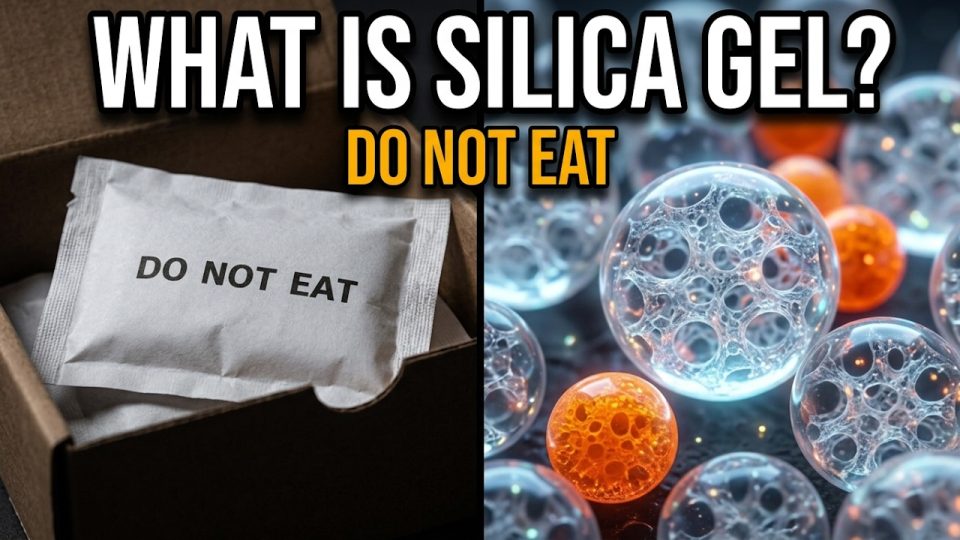
What Is Silica Gel? Why There’s Always a “Do Not Eat” Packet in Everything You Buy
Open any shoe box, medicine bottle, or new gadget, and you’ll find a tiny packet that says DO NOT EAT. Have you ever wondered what is inside it, and why it ships with almost everything you buy?
That packet holds silica gel. Despite its name, it is a hard, glassy solid built from silicon and oxygen atoms linked in a three-dimensional network. A single gram of these beads hides roughly 800 square meters of internal surface, about three tennis courts folded into a pinch you could barely feel between your fingers. Its tiny pores don’t soak up water like a sponge (absorption). They trap water vapor on their pore walls (adsorption), which is why the beads stay dry and hard even when they are full of moisture.
In this video we follow silica gel from raw sand to the finished sachet. Quartz sand and soda ash are melted into water glass (sodium silicate). Mixing it with sulfuric acid forms a wobbling hydrogel, which is shaped into beads, aged, washed, shrunk by syneresis, dried, activated, sized, and sealed into packets. We also explain how blue-to-pink cobalt indicator gel and orange methyl violet gel change color as they fill with moisture. You’ll see how silica gel protects medicines, electronics, cargo in shipping containers, transformers, compressed-air systems and laboratory columns, and how the beads can be heated, recharged and reused.
The next time you see that little packet, you’ll know the chemistry quietly protecting your world.
Never eat the packet, and keep it away from children and pets.
