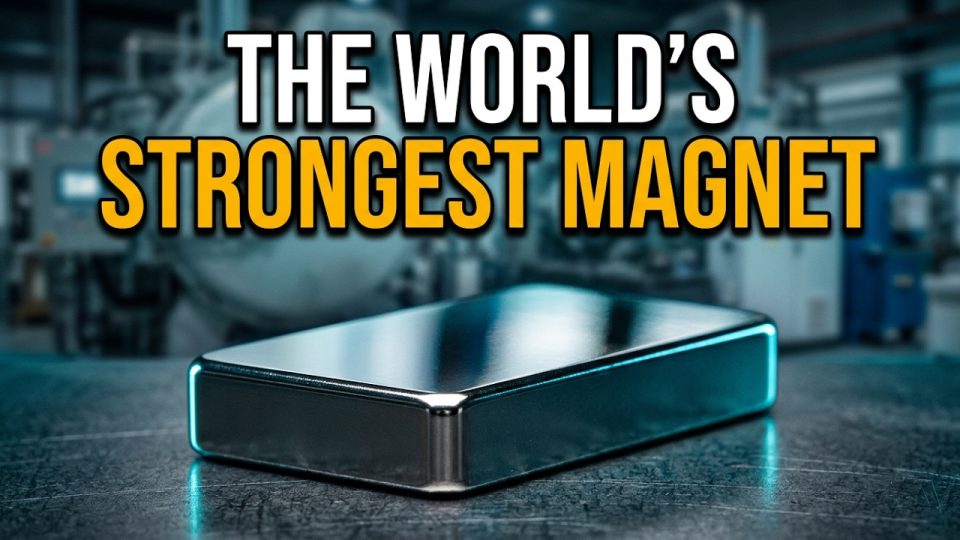
How the World’s Strongest Magnet Is Made
This brittle grey block is the strongest commercial permanent magnet on Earth. Two of them can slam together hard enough to shatter, and a pinch can badly injure a hand. Yet the same material drives most electric cars. So how does a lump of rock become this?
Neodymium magnets store up to 52 MGOe of magnetic energy, roughly 13 times more than an ordinary ceramic magnet of the same size. That is why electric motors, headphones, and wind generators could shrink so dramatically.
The complete process, from rock to magnet:
Where they live: Many electric cars use neodymium motors with efficiency above 95 percent. A single 2.5 MW direct-drive wind turbine can hold about one tonne of magnets. They also sit inside hard drives, phone speakers, haptic motors, and some MRI scanners.
The crystal: The secret is Nd₂Fe₁₄B: two neodymium atoms, fourteen iron atoms, one boron atom. Iron supplies the magnetism, neodymium locks each atom’s magnetic direction in place, and boron holds the lattice together. That lock is called coercivity, the resistance to being demagnetized.
Mining and refining: Neodymium is not actually rare, just hard to separate. It comes mainly from bastnäsite and monazite, mined at Bayan Obo in China, Mountain Pass in California, and Mount Weld in Australia. Flotation lifts the concentrate to around 60 percent rare earth oxide. Hundreds of solvent-extraction stages then split neodymium from its chemical twins, producing neodymium-praseodymium oxide, which is electrolyzed in molten fluoride salt into metal. China handles roughly 85 to 90 percent of this refining.
Melting and strip casting: The metals are weighed to recipe, roughly 30 percent neodymium, 65 percent iron, and one percent boron, and melted by induction under vacuum. The melt is poured onto a water-cooled copper wheel and freezes instantly into paper-thin flakes about a third of a millimeter thick.
Hydrogen decrepitation: The flakes sit in hydrogen gas. The neodymium-rich grain boundaries absorb hydrogen and swell, cracking the flakes from the inside into coarse powder with no mechanical force.
Jet milling under inert gas: Supersonic nitrogen jets make particles smash into each other until they are just two to five micrometers wide, about twenty times thinner than a human hair. At this size, the powder is pyrophoric and can ignite spontaneously in air, so every step runs sealed under nitrogen or argon.
Alignment and pressing: The powder is poured into a die, and a powerful magnetic field is switched on while the grains are still loose. Every tiny crystal swings round to point the same way. Hydraulic punches then squeeze the powder into a block, a green compact only about half-full density and as fragile as chalk. Cold isostatic pressing evens out the density before the oven.
Sintering and heat treatment: In a vacuum furnace at roughly 1,040 to 1,080°C for about an hour, the neodymium-rich boundary phase turns liquid and flows between the grains, pulling the block to near full density. Aging at about 900°C and then 500°C tunes the grain boundaries. Heavy rare earths, dysprosium and terbium, are often diffused in to resist heat, because plain neodymium magnets lose their magnetism near 310°C.
Machining and plating: Sintered neodymium is hard and brittle like ceramic, so it is cut with diamond wire saws, ground flat, and shaped by wire EDM, all while still unmagnetized. Left bare, it rusts fast, so each magnet gets a nickel-copper-nickel coating about 20 micrometers thick, sometimes topped with epoxy.
Pulse magnetization: Only now does the block become a magnet. A capacitor bank sends thousands of amps through a coil for a few milliseconds, forcing every aligned crystal into saturation.
The supply chain race: China makes around 90 percent of the world’s sintered neodymium magnets. After licensing of rare earth magnet and heavy rare earth exports began in April 2025, magnet exports fell 45 percent year on year that month. The US Department of Defense has since agreed a 10-year price floor of $110 per kilogram for NdPr oxide with MP Materials, backing a Western rebuild that includes a planned 10,000-tonne-per-year magnet plant due to start commissioning in 2028.
From rock in a mine to the strongest permanent magnet you can buy: melted, shattered by hydrogen, milled in nitrogen, aligned in a field, sintered, plated, and magnetized.
