How Cement Is Made? The Incredible Process Behind High-Temperature Kilns
Right now, inside a rotating steel cylinder the size of a 10-story building, rock is being burned at 1,450 degrees Celsius. A fireball the size of a house is transforming limestone into the chemical glue holding every building, bridge, and road you have ever used. Concrete is the second most consumed substance on Earth after water. And the process that makes it is one of the most chemically precise, energy-intense industrial operations ever devised.
The complete process, from quarry to concrete:
Quarrying and raw materials: Portland cement requires a precisely controlled blend of four raw materials. Limestone provides about 80 percent of the raw mix—the source of calcium oxide. Clay or shale provides silica and alumina. Iron ore provides iron oxide. A typical cement plant processes 5,000 tonnes of raw material daily to keep the kiln running. The target chemical composition is approximately 65 percent CaO, 20 percent SiO₂, 5 percent Al₂O₃, and 3 percent Fe₂O₃. Any deviation at this stage propagates all the way through to the final cement strength, which is why every batch is monitored by continuous X-ray fluorescence analysis.
Grinding to raw meal: The blended raw materials are fed into a vertical roller mill or ball mill, ground to a fine powder — the raw meal — with particles typically below 90 micrometers in size. This ultrafine grinding maximizes chemical reaction surface area in the kiln. The raw meal is then homogenized in blending silos using compressed air to achieve a uniform chemical composition within 1 percent of the target CaO content before entering the kiln system.
Cyclone preheater tower: Before entering the kiln, the raw meal descends through a cyclone preheater tower — 50 to 120 meters tall — with five or six suspension preheater stages. Each stage uses hot exhaust gas rising from the kiln to heat the falling raw meal. By the time it reaches the base of the tower, the raw meal is at approximately 850 degrees Celsius — absorbing waste heat that would otherwise be lost and reducing fuel consumption by up to 40 percent.
Precalciner and calcination: At the base of the preheater tower, the precalciner drives the most energy-intensive chemical reaction in cement making: calcination. At approximately 900 degrees Celsius, limestone decomposes: CaCO₃ → CaO + CO₂. This single reaction drives off approximately 60 percent of the total CO₂ produced in cement making. This CO₂ comes from the rock itself — not from fuel. No amount of renewable energy can stop it. Only carbon capture can address this fraction.
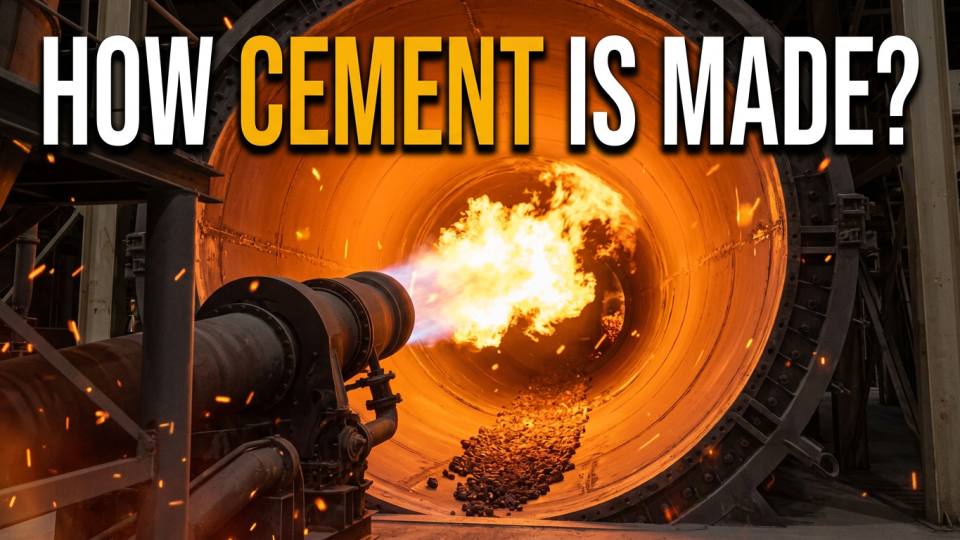
Inside the rotary kiln: The pre-calcined raw meal enters the rotary kiln — a steel cylinder up to 6 meters in diameter and 100 meters long, lined with refractory brick, rotating at 1 to 4 revolutions per minute and inclined at 3 degrees. Material travels from the feed end to the discharge end over 20 to 30 minutes as the temperature rises progressively. The burning zone reaches 1,450 degrees Celsius — hot enough to cause partial melting. In this liquid phase, calcium oxide and silica react to form alite (C₃S), tricalcium silicate, responsible for concrete’s early strength. Modern cement kilns co-process alternative fuels — waste tyres, animal meal, municipal waste — alongside coal and petroleum coke. The extreme temperature ensures complete destruction of any hazardous organic compounds.
The four clinker minerals: At 1,300 to 1,450 degrees Celsius in the liquid phase, four hydraulic mineral phases form. Alite — C₃S — makes up approximately 58 percent of clinker and provides early concrete strength within 28 days. Belite — C₂S — at 23 percent provides long-term strength over months and years. C₃A — tricalcium aluminate at 8 percent — drives fast initial setting. C₄AF — ferrite at 8 percent — gives clinker its characteristic grey colour. The burning zone temperature must be precisely maintained: too cool and alite won’t form; too hot and the melt becomes unworkable.
Clinker cooler, shock-chilling: As red-hot clinker exits the kiln at 1,200 degrees Celsius, it falls onto a reciprocating grate cooler where ambient air is blown upward through the clinker bed. This shock-chilling is critical: if clinker cools too slowly through the 900 to 1,250 degree range, alite converts back to belite — destroying the early strength properties the kiln just created. Hot secondary air from the top of the cooler is recycled back into the kiln, recovering up to 30 percent of the clinker’s thermal energy. Cooled clinker — dark grey, hard, and ambient — is conveyed to storage.
Final grinding with gypsum: Clinker is ground in a ball mill or vertical roller mill with about 3 to 5 percent gypsum (calcium sulfate). Without gypsum, cement would flash-set within minutes of adding water because C₃A reacts instantaneously. Gypsum retards this by forming ettringite on the C₃A surface, giving concrete workable time. The finished cement — particles of 3 to 30 micrometers — has a Blaine specific surface area of 300 to 400 square meters per kilogram. When water is added, this surface drives rapid hydration, forming calcium silicate hydrate — the gel that bonds concrete into solid stone.
The CO₂ challenge: Cement produces approximately 7 to 8 percent of all global CO₂ emissions — 1.47 billion tonnes of process CO₂ in 2024. About 60 percent comes from limestone decomposition, not fuel—which is why electrification alone cannot decarbonize cement. Carbon capture and storage is the only path to eliminating this fraction. The remaining 40 percent from fuel can be addressed through alternative fuels, efficiency improvements, and eventually electrified kilns.
4 billion tonnes per year. 1,450 degrees Celsius. The second most consumed substance on Earth. And 8 percent of global CO₂ is locked in rock chemistry.
