Paper Title: Hybrid CNN-LSTM model for urban air pollution forecasting: towards early warning systems for public health: a case study of Baghdad and Basra
Authors: Israa Nadheer, Mohammed Imad Aal-nouman
Corresponding Author: Mohammed Imad Aal-nouman (m.aalnouman@nahrainuniv.edu.iq)/ Iraq
Abstract
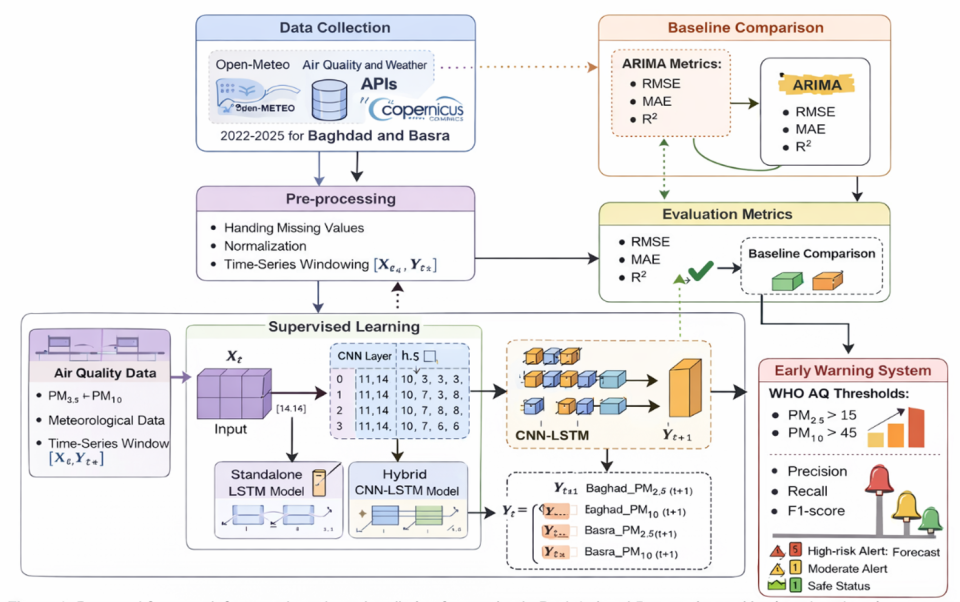
Air pollution has become a critical issue in environmentally challenged regions due to rapid urbanization, especially in countries where forecasting tools remain underdeveloped. Despite the success of deep learning approaches in predicting air quality, there has been little research on multivariate forecasting of particulate matter in Iraqi cities using publicly accessible environmental information. This study proposes a CNN-LSTM architecture to predict the concentrations of PM₂.₅ and PM₁₀ the following day in Baghdad and Basra. Environmental data related to air quality, along with temperature, relative humidity, wind speed, and seasonal cyclical features, were used to generate multivariate time series with a 14-day lookback window. The proposed model was compared with an LSTM model and a conventional autoregressive integrated moving average model using 1,249 daily data samples collected from August 2022 to December 2025. The results reveal that the deep learning models outperformed the statistical baseline, and the LSTM approach exhibited the best generalization performance. A threshold-based pollution alert module was also implemented to demonstrate how continuous concentration forecasts can support operational air quality warning systems. The findings demonstrate the applicability of multivariate deep learning for short-term urban air pollution forecasting in data-constrained environments and provide a baseline framework for future environmental monitoring systems in Iraq.
