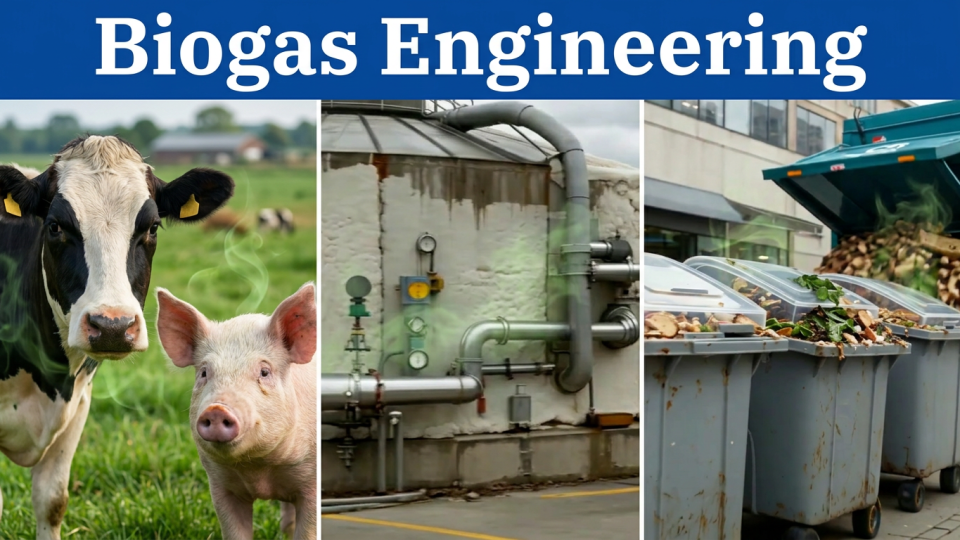
Biogas Engineering: Which Waste Actually Yields the Most Power?
Anaerobic digestion is one of the most consequential biological engineering processes on Earth, yet the single variable determining whether a biogas plant generates profit or operates at a loss remains widely misunderstood: feedstock selection. The global biogas and biomethane market was valued at $88.9 billion in 2024, yet the International Energy Agency estimates only 5 percent of the world’s sustainable biogas potential is currently being exploited.
This documentary examines the complete engineering and biochemistry of biogas production from first principles. We analyze why lipids yield 1.0 cubic meters of methane per kilogram of volatile solids — 2.6 times the output of carbohydrates at 0.38 m³/kg VS- driven by the superior hydrogen-to-carbon ratio of fats relative to starches and proteins. We investigate how meat and dairy food waste fractions generate 337 milliliters of methane per gram of COD against just 171 mL/gCOD for vegetable and grain fractions, and why used cooking oil can push digester methane content above 70 percent.
We document the four-stage anaerobic digestion process — hydrolysis, acidogenesis, acetogenesis, and methanogenesis — operating inside continuously stirred tank reactors at mesophilic temperatures of 35 to 37 degrees Celsius, and examine why thermophilic operation at 55 degrees increases throughput at the cost of process stability. We explain the LCFA inhibition mechanism that makes high-lipid mono-digestion operationally hazardous, and why two-stage digestion separates hydrolytic pre-acidification from methanogenesis to overcome it.
The lignocellulosic challenge receives rigorous treatment: crystalline cellulose and lignin structures in wheat straw and corn stover resist bacterial hydrolysis, necessitating steam explosion at 180 to 200 degrees Celsius, alkaline pretreatment with sodium hydroxide, or intensive mechanical milling — processes whose energy costs can consume most of the methane yield advantage. We evaluate sewage sludge and slaughterhouse co-digestion, membrane upgrading and pressure swing adsorption to pipeline-grade 97 percent biomethane, and present the peer-reviewed verdict: co-digestion of source-separated food waste with livestock manure produces 26 percent more methane than the sum of individual digestions, combining lipid energy density with the natural microbial consortium that makes the process stable and bankable.
