Paper Title: Harnessing wind and solar power for electric vehicle charging: a feasibility study at Ikas supermarket, Lefkosa, Northern Cyprus
Authors: Youssef Kassem, Hüseyin Çamur, Ahmad Hussein
Corresponding Author: Youssef Kassem (yousseuf.kassem@neu.edu.tr)/Cyprus
Abstract
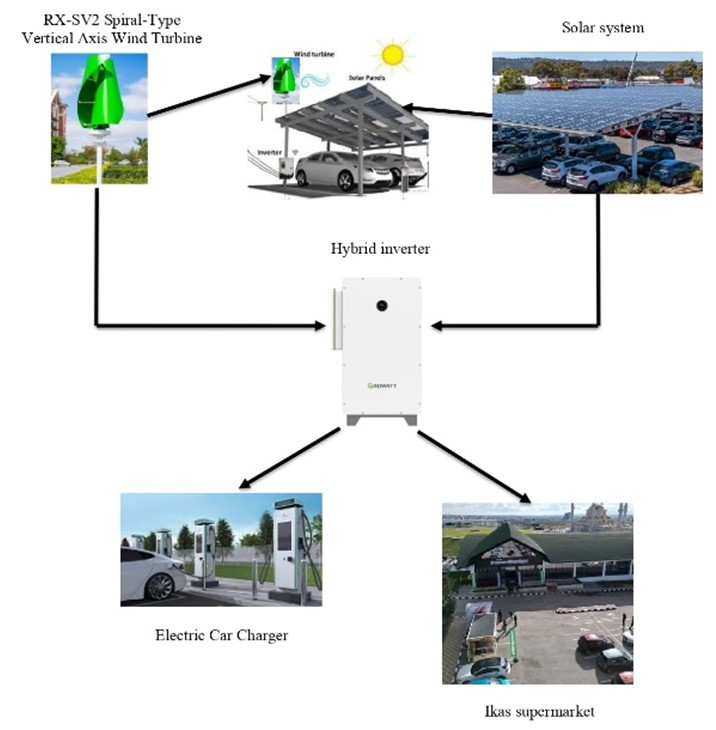
Electric vehicles (EVs) have replaced conventional bio-fuel cars over the past ten years. Electric vehicles, or EVs, have become popular for both financial and environmental reasons. One of the most significant challenges facing humanity today is environmental degradation. From both an economic and ecological perspective, it would be highly beneficial if electric automobiles could be charged using renewable energy. The use of EVs in Northern Cyprus remains in its early stages. Thus, the viability of charging from renewable sources is investigated. In addition to comparing fuel-based and electric vehicles and determining the economic viability of charging using renewable sources, the study explains ways to charge electric vehicles using hybrid wind and solar power systems. The costs of the required components have been obtained from manufacturers, and the average cost is then taken into account. The results demonstrated that the developed system achieved a maximum monthly energy output of 13,500 kWh in March and ensured stable production throughout the seasons by utilizing solar and wind resources in combination. Additionally, it has the capacity to support 58 EV chargers per day, which can charge approximately 1,700 EVs per month, including the GÜNSEL B9 model. Economically, the system was extremely viable with a payback time of just 3.34 years when electricity was sold at $0.31/kWh. Moreover, the proposed system offered a significant 96% reduction in carbon emissions compared to conventional grid electricity. These results demonstrate the hybrid system’s success in facilitating sustainable, high-capacity EV charging, yielding significant environmental and economic benefits. Additionally, compared to fuel vehicles, EVs are almost twice as advantageous and environmentally friendly.
Keywords
Electric car, Renewable resource, Cost-benefit analysis, Solar energy, Wind energy
