Paper Title: Specification-driven feasibility and techno-economic assessment of recycling and valorization of HTV silicone rubber manufacturing scrap from composite insulator production
Author: Kadir Aydin
Corresponding Author: Kadir Aydin (kadir.aydin@ostimteknik.edu.tr)/ Türkiye
Abstract
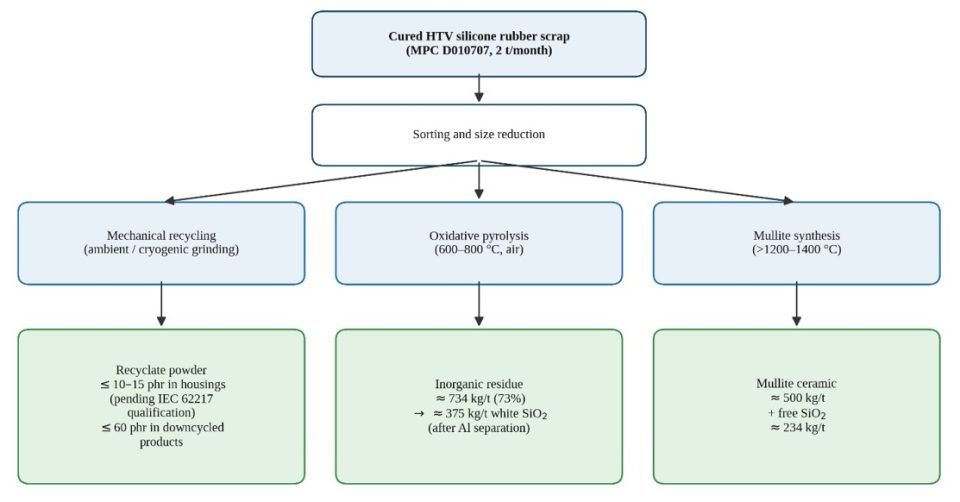
Composite silicone insulators are rapidly displacing ceramic and glass units in high-voltage transmission, and their manufacture generates substantial cured high-temperature-vulcanized (HTV) silicone rubber scrap that is chemically inert and non-degradable. This study presents a specification-driven feasibility and techno-economic assessment of recycling and valorizing 24 t/year (2 t/month) of cured HTV scrap (grade MPC D010707) generated in the production of 170 A/B, 170 C and 420 A/B composite insulators. Using the manufacturer quality specification together with the stoichiometry of aluminum trihydroxide (ATH) dehydration, a compositional model of approximately 55 wt% ATH, 5 wt% reinforcing silica, and 40 wt% polydimethylsiloxane (PDMS) is inferred without new laboratory characterization. Three valorization routes are modeled: mechanical recycling by ambient and cryogenic grinding with reincorporation into virgin compound; oxidative pyrolysis to recover a silica-rich inorganic residue; and high-temperature mullite synthesis. A linear property-degradation model, anchored to a recent peer-reviewed high-consistency rubber recyclate dataset, shows that mechanical property loss is not the binding constraint. Instead, the particle-size specification of 10 µm median diameter and the tracking and erosion requirement of class 1A4.5 restrict reincorporation into insulator housings to roughly 10 to 15 parts per hundred rubber (phr) until qualified by testing, whereas downcycled products tolerate up to 60 phr. Stoichiometric mass balances give a 73% inorganic yield for oxidative pyrolysis, of which 375 kg/ton is a high-value silica fraction, and 500 kg/ton mullite for the ceramic route. Techno-economic modeling identifies ambient mechanical recycling as the most attractive first investment, with a capital expenditure near USD 21,000 and a payback below one year, contingent on internal absorption capacity, with recovered-silica pyrolysis as a strategic second phase. The work is presented explicitly as a modeling and techno-economic feasibility study based on manufacturer specification data and literature-derived property models.
