The $16 Trillion Treasure on the Ocean Floor
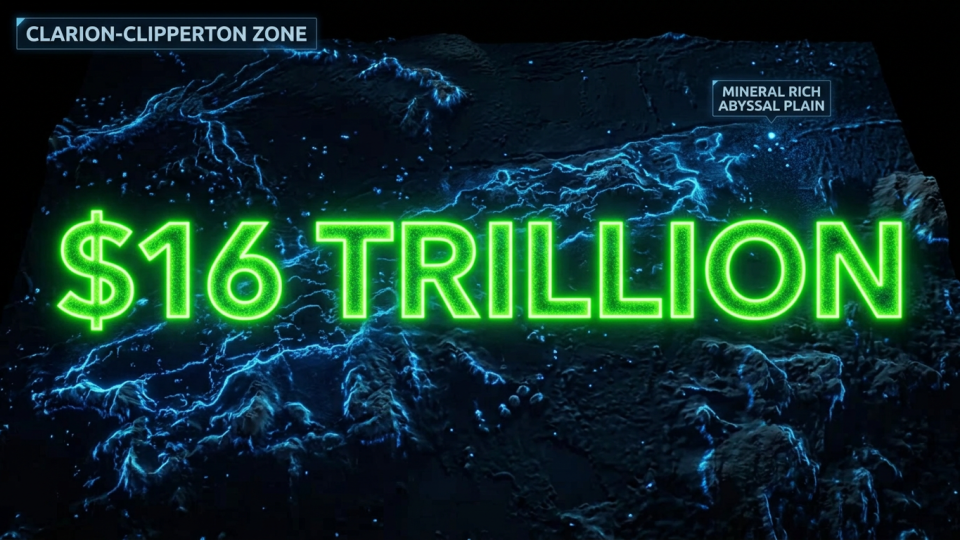
We have mapped nearly 100 percent of the surface of Mars. We have mapped less than 25 percent of our own ocean floor. Sitting on that unmapped seabed, at 4,000 to 6,000 meters below the surface in complete permanent darkness, are 21 billion dry tonnes of polymetallic nodules — potato-shaped rocks containing cobalt, nickel, copper, and manganese worth an estimated $16 trillion. The Clarion-Clipperton Zone alone, stretching 4.5 million square kilometers across the Pacific between Hawaii and Mexico, contains more nickel, cobalt, and manganese than all known land-based reserves combined.
This documentary covers the complete engineering, geopolitics, regulation, and environmental science of deep-sea mining. The Hidden Gem — a 228-meter vessel operated by Allseas — is the world’s first purpose-built subsea mineral production vessel. Its 12-meter ROV collector operates at 600 atmospheres of pressure, 4,500 meters below the surface, pumping nodules through a 4.5-kilometer riser pipe. In 2022, the system lifted 3,000 tonnes at 86 tonnes per hour in a 60-day pilot trial.
In April 2025, President Trump signed an executive order fast-tracking US seabed mining permits, bypassing the UN International Seabed Authority. TMC’s stock surged 520 percent. NOAA confirmed TMC’s application was fully compliant. A commercial recovery permit is expected by Q1 2027 — the first in history. Meanwhile, the ISA mining code failed again in July 2025, 32 countries demanded a moratorium, and 700 scientists warned that most CCZ species are unknown to science. In 2024, researchers discovered that nodules generate oxygen through natural electrolysis in complete darkness — a finding that fundamentally changes the environmental calculus.
China holds exploration licenses across three ocean basins. India operates exclusively in the Central Indian Ocean Basin. Japan has found 610,000 tonnes of cobalt — 75 years of national consumption — in CCZ samples. 31 contractors are racing to claim exploration rights. Meanwhile, LFP batteries already represent 40 percent of EV sales with no cobalt required, and CATL’s sodium-ion batteries need no lithium, cobalt, or nickel at all. The entire premise of deep-sea mining may be disrupted before the first commercial permit is issued.
