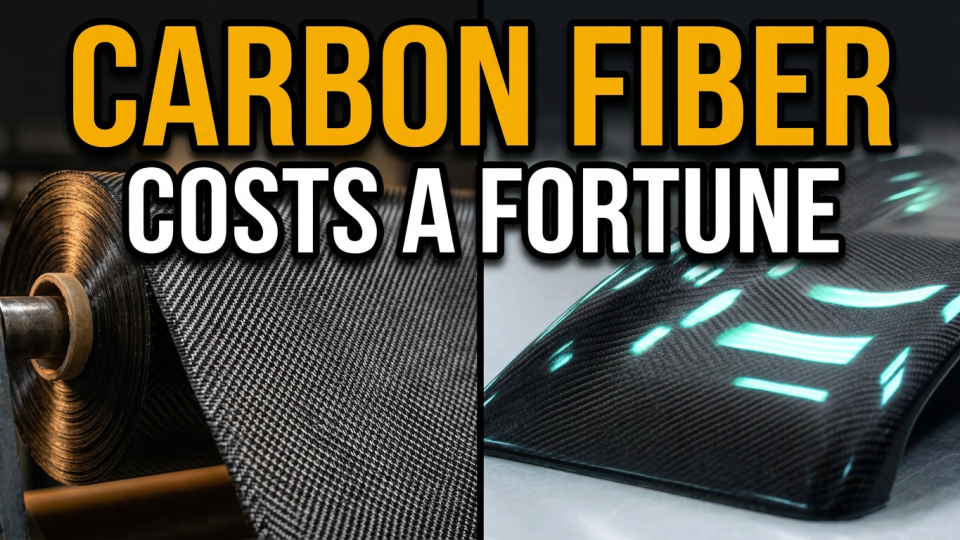
What Makes Carbon Fiber So Valuable?
Carbon fiber is one of the strongest, lightest engineering materials in use today. It appears in aircraft, race cars, wind turbine blades, hydrogen tanks, and sports equipment. Yet it costs far more than steel or aluminum. The reason is not rarity. Carbon is everywhere. The cost comes from how the material is made.
Most carbon fiber starts as polyacrylonitrile (PAN), an acrylic plastic fiber. Manufacturers spin it into extremely uniform thread, since tiny flaws can sharply reduce the final strength. The thread is then stabilized in air at roughly 200 to 300 °C. This step is exothermic, so it must be controlled carefully to avoid overheating and fusing, and it can take hours. Next comes carbonization at about 1,000 to 1,500 °C in nitrogen, which drives off hydrogen, nitrogen, and oxygen, leaving tightly bonded carbon sheets. Some high-modulus fibers receive an additional heat treatment above 2,000 °C.
A large share of the original fiber is lost along the way. PAN typically yields about 50 to 60 percent carbon, and the precursor alone accounts for roughly half of the finished cost. Commercial fiber is commonly priced around 20 to 30 dollars per kilogram.
The fiber is not yet a part. It must be woven or laid into plies, combined with epoxy resin, shaped on a mold and cured, often in an autoclave at about 180 °C and 6 bar of overpressure. Complex shapes are still frequently laid by hand.
Researchers and manufacturers are working on cheaper routes, including lignin-based precursors, faster automated tape laying, and recycled fiber that keeps roughly 80 to 90 percent of its strength. None of these is yet at a large commercial scale. Lower costs could widen the use of carbon fiber in lighter, more efficient machines.
