Paper Title: Meta-learning-driven agent architecture optimization for autonomous self-correcting agents
Authors: Zifa Liu
Corresponding Author: Zifa Liu ( zfliuedu@phc.ac.cn)/China
Abstract
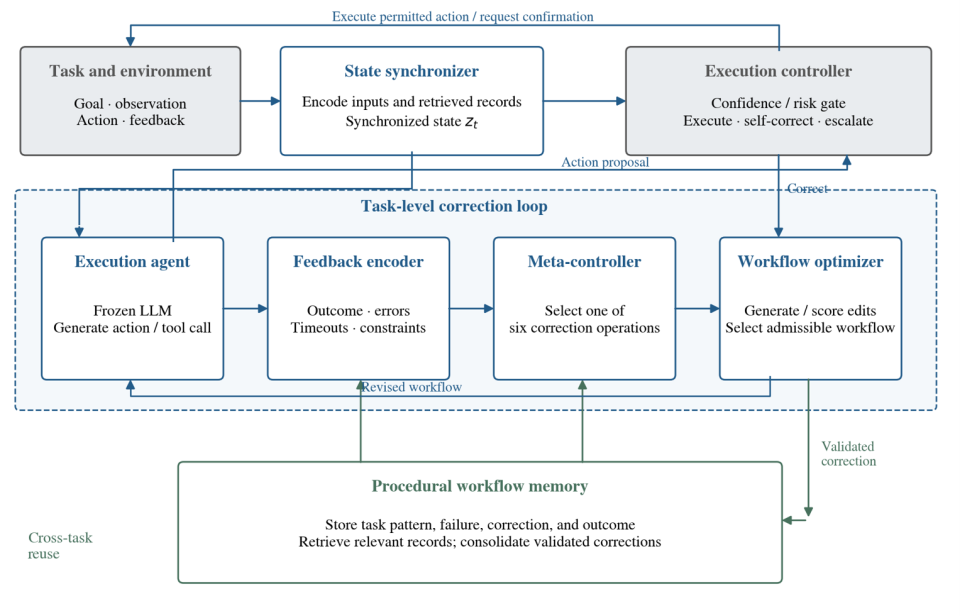
Large language model agents must be able to recover from task failures, accumulate effective experience, and maintain an appropriate balance in the frequency of human intervention. This study proposes MetaSCA, a meta-learning-based self-correcting agent. Based on a frozen Qwen2.5-7B-Instruct model, MetaSCA employs a lightweight controller, prompt and workflow optimization, and procedural memory to enable agents to adjust their execution processes based on task feedback. Furthermore, the system assesses the task’s confidence and potential risks based on current execution results and then selects the next processing method accordingly. According to the evaluation scheme in the research, MetaSCA achieved a task success rate of 54.6 ± 1.7% in five experiments on WebArena, higher than the 48.8 ± 2.0% achieved by Promptbreeder. The ratios of MetaSCA for the two indicators of manual intervention and constraint violation were 15.2 +/- 1.4% and 6.2 +/- 1.4. Those of Promptbreeder were 13.9 +/- 1.5% and 9.2 +/- 1.0%. Later ablation experiments and perturbation analysis examine the effects of the correction strategies, memory mechanisms, and manual intervention on the system performance. Appendix A presents the analysis of the risk calibration and intervention selection decision rules.
