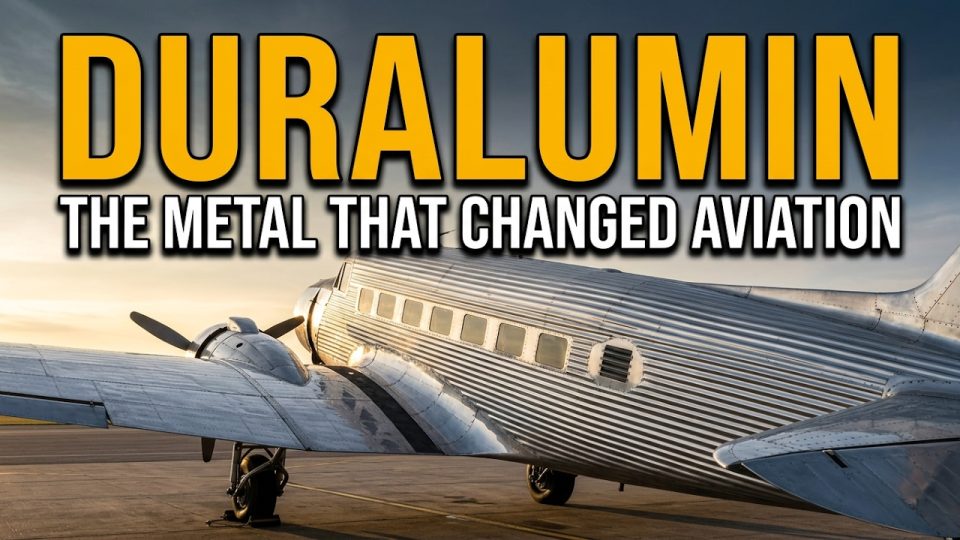
Duralumin: The Soft Metal That Gets Stronger Just by Waiting (and Built the Modern Airplane)
Duralumin is the original high-strength aluminum alloy and the ancestor of the 2000-series alloys that still build aircraft today. Around 1906, German metallurgist Alfred Wilm found that an aluminum–copper alloy hardened by itself after quenching, simply by resting at room temperature. The effect is called age hardening. The alloy was soon licensed through Dürener Metallwerke and used for airship frames and early aircraft.
Its modern descendant, alloy 2024, contains roughly 4.4% copper, 1.5% magnesium and 0.6% manganese. It is cast into large ingots, homogenized, then hot rolled, cold rolled or extruded. The key step is solution heat treatment near 495 °C, which dissolves copper evenly into the aluminum. A rapid water quench traps it there. Over the following days, copper atoms gather into Guinier–Preston zones, tiny clusters that block the sliding of atomic planes and make the metal far harder. Some parts are also artificially aged at about 190 °C.
The result: 2024-T3 reaches about 485 MPa tensile strength, against under 100 MPa for soft pure aluminum, while weighing roughly a third as much as steel. Its weakness is corrosion, because copper creates tiny electrochemical differences along grain boundaries. The fix, announced in 1927, was Alclad: a strong alloy core clad in thin pure aluminum, first used on the ZMC-2 airship.
Today is a standard choice for fuselage skins and lower wing skins because it tolerates damage. Cracks grow slowly and can be found at inspection. Its relatives include 2519 armor plate, 2618 forged pistons, and 2000-series rivets.
