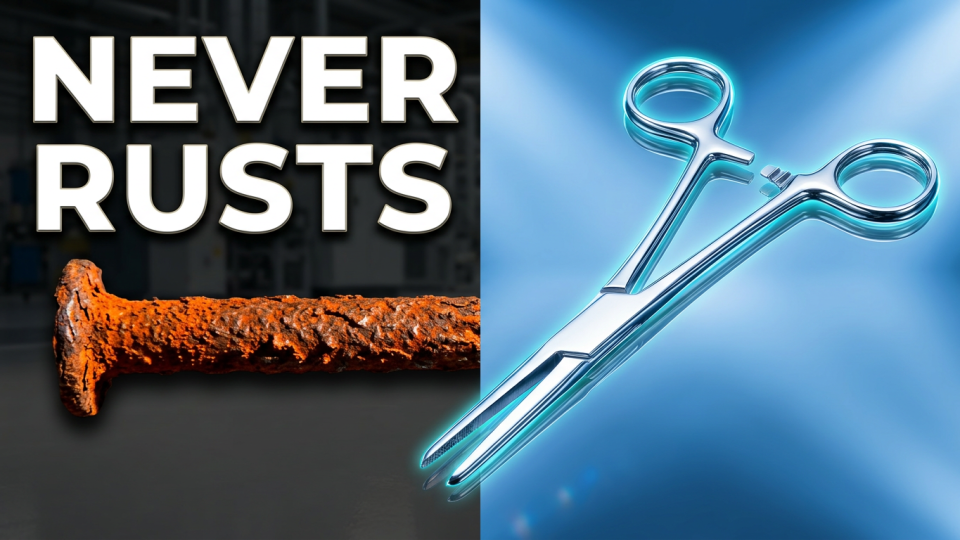
The Science of Stainless Steel | Why It Never Rusts
Why does an ordinary steel nail rust in days, while a stainless-steel surgical instrument can survive twenty years of sterilization and still look almost new? The answer is not a coating. It is chemistry, happening at the surface of the metal, in a layer so thin that 30,000 of them stacked together equal the thickness of one human hair. That invisible layer is called the passive film. It forms the moment stainless steel meets oxygen. It seals the surface. And when it is scratched, it rebuilds itself in seconds.
The complete science:
Why ordinary steel rusts: Steel is mostly iron. When iron meets oxygen and water- rain, humidity, morning dew- it forms iron oxide. That is rust. A red powder that flakes off, exposing fresh metal below, which then rusts again. It is a cycle with no natural endpoint.
The 10.5% chromium threshold: When chromium is added to steel at a concentration of at least 10.5 percent, something extraordinary happens. The chromium reacts instantly with oxygen in the air and forms an ultra-thin chromium oxide barrier across the entire surface — not a coating you can see, but chemistry you cannot. Unlike iron oxide, which is porous and flaking, chromium oxide is extraordinarily dense and adhesive. It bonds tightly to the metal below. It does not flake. It does not peel. It blocks oxygen and water from reaching the iron beneath.
The self-healing passive film: The most remarkable thing about this barrier is that it repairs itself. Scratch a stainless steel surface — and within seconds, oxygen from the surrounding air reacts with the freshly exposed chromium atoms and rebuilds the barrier. Not in hours. Not after treatment. In seconds. Think of it like a self-healing paint that never runs out, never needs reapplying, and works faster as the damage gets worse. The more oxygen that reaches the scratch, the faster the repair.
Inside the Electric Arc Furnace: Creating stainless steel begins with melting inside an Electric Arc Furnace — three graphite electrodes striking electrical arcs that reach around 3,500 degrees Celsius, hotter than the surface of the sun, melting recycled scrap and chromium alloys. After roughly 75 to 80 minutes, consuming around 450 kilowatt-hours of electricity per tonne, the furnace tilts and pours the molten metal at 1,500 to 1,600 degrees Celsius into a transfer ladle. The steel is liquid — but not yet stainless.
The AOD process — the most important step: The molten steel moves to the Argon Oxygen Decarburization vessel. Over 75 percent of the world’s stainless steel passes through this process. The AOD’s job: remove carbon without losing chromium. Carbon makes steel brittle, but removing it requires oxygen — and oxygen also destroys chromium. The solution is argon gas. By blowing a mixture of oxygen and argon simultaneously, the argon dilutes the carbon monoxide that forms, lowering the pressure needed to drive off carbon without oxidizing the chromium. Carbon leaves. Chromium stays. The final carbon content drops to under 0.05 percent.
From slab to stainless sheet: The refined liquid is cast into slabs typically 200 millimeters thick, reheated to around 1,200 degrees Celsius, then hot rolled from 200mm down to a few millimeters across multiple rolling stands. Cold rolling and annealing follow, then pickling—an acid bath that removes oxide scale from the surface. The final product can be mirror-polished, satin-brushed, or finished to the 2B standard used in most industrial applications.
Grade 304 vs Grade 316: Grade 304 contains 18 percent chromium and 8 percent nickel, the material in your kitchen sink, cutlery, coffee pot, and dishwasher drum. Grade 316 adds molybdenum at 2 to 3 percent, making the passive film more resistant to chloride ions found in seawater and salt solutions. This is why 316 is standard for marine environments, surgical instruments, pharmaceutical equipment, and chemical plants.
When stainless steel can fail: Stainless steel is not indestructible. Chloride contamination can penetrate the passive film and initiate pitting corrosion, small deep holes that eat through the metal from inside while the surface looks almost undamaged. Three other failure conditions: contact with carbon steel tools or equipment (iron particles embed and rust from outside in), high temperatures above 800 degrees Celsius (which destabilise the film), and crevices where oxygen cannot reach (preventing the film from repairing itself). Understanding these limits is how engineers keep stainless steel performing for decades.
Why it matters: In 2024, the world produced over 60 million tonnes of stainless steel — a market worth roughly $140 billion. The Chrysler Building’s crown. Hospital piping. Brewery tanks. Airport terminal cladding. Chemical plant reaction vessels. Medical implants inside human bodies. All protected by a film three nanometres thick that forms automatically the moment the metal meets air.
Stainless steel doesn’t avoid corrosion because it’s invincible. It survives because its chemistry creates a protective shield that constantly fights to repair itself.
