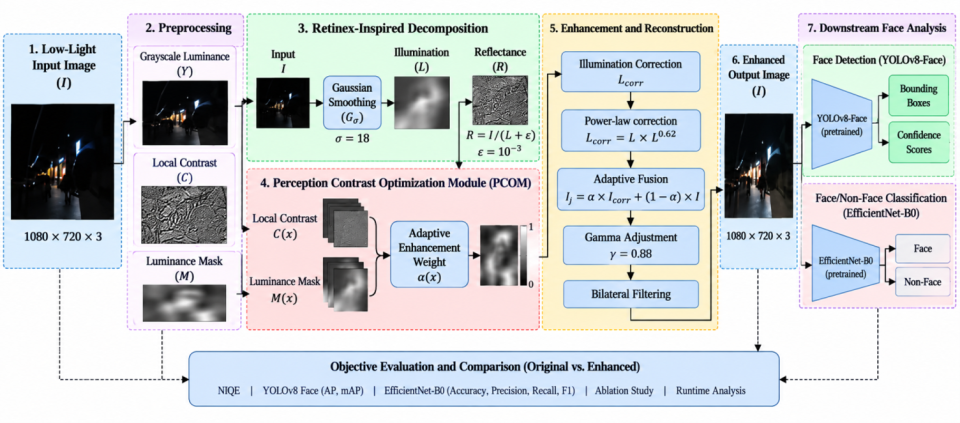
Paper Title: Perception-guided Retinex-inspired framework for low-light facial image enhancement and robust face analysis
Authors: Mohammed S. H. Al-Tamimi, Roaa S. Abed Alah, Sarah Riyadh Adnan
Corresponding Author: Mohammed S. H. Al-Tamimi (mohammed.s@sc.uobaghdad.edu.iq)/Iraq
Abstract
Low-light facial images often suffer from reduced visibility, noise, color distortion, and loss of structural information, which can degrade subsequent face-analysis performance. This study proposes a perception-guided framework for single-image low-light facial enhancement based on Retinex-inspired illumination–reflectance decomposition and spatially adaptive enhancement. Local contrast and luminance-masking cues are incorporated through a Perception Contrast Optimization Module (PCOM) to regulate enhancement intensity across differently illuminated regions. Illumination correction, perception-guided adaptive fusion, and edge-preserving post-processing are subsequently applied to improve facial visibility while maintaining relevant structural information. Experiments were conducted on a held-out set of 900 DARK FACE images using no-reference image-quality assessment and downstream face-analysis tasks. Enhancement reduced the mean NIQE score from 4.8652 to 4.7828. Using a fixed YOLOv8-Face detector, AP@0.50 increased from 16.80% to 26.22%, while mAP@0.50:0.95 increased from 4.99% to 7.82%. In binary Face/Non-Face classification, ImageNet-pretrained EfficientNet-B0 achieved 95.22% accuracy and 99.08% recall on enhanced samples, compared with 95.69% accuracy and 91.74% recall on the corresponding original samples. The results demonstrate that the proposed enhancement substantially improves downstream face detectability and Face recall under challenging low-light conditions. However, a trade-off is observed in some perceptual-quality and precision measures.
