Paper Title: Multi-objective reinforcement-learning simulation for co-optimizing resource circularity and environmental performance in circular manufacturing
Authors: Ting Li, Logaiswari Indiran
Corresponding Author: Ting Li (l.ting@graduate.utm.my)/Malaysia
Abstract
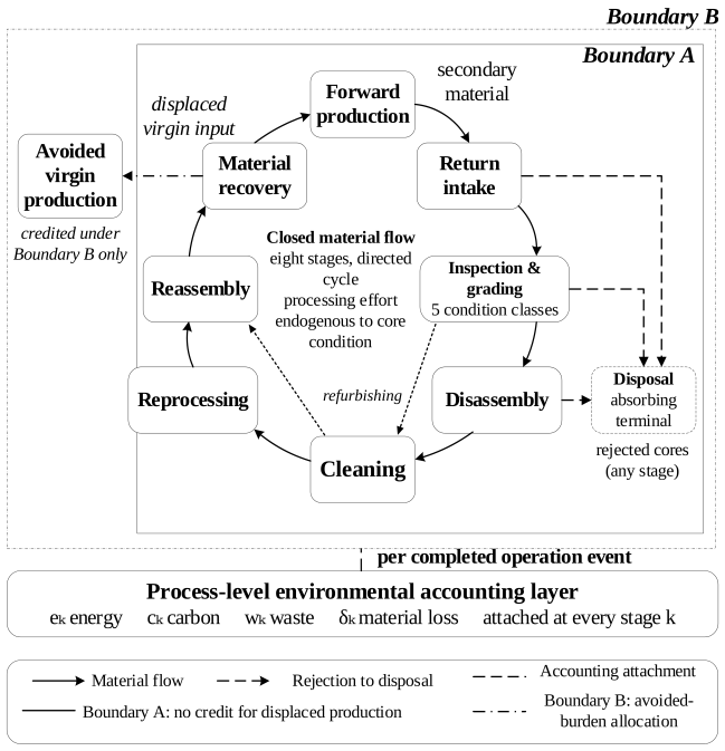
More regulations require manufacturers to enhance material circularity and reduce their environmental footprint simultaneously; however, it remains unclear whether these two objectives align, and if so, in which domain. A discrete event simulation model for a remanufacturing plant operating multiple production lines with environmental performance measures at the process level is defined as a multiobjective Markov decision process, which is then solved using a preference-conditioned actor–critic technique, employing feasibility masking for the precedence and capacity constraints and adaptive sampling between the surrogate model and the full-scale simulator. Two life cycle accounting methods have been used: Boundary A (cut-off) and Boundary B (avoided burden). The environmental burden reveals three regimes, synergistic, trade-off, and inverted, characterized by transition points in secondary-material input levels at 0.38 and 0.61 for Boundary A and at 0.47 and 0.78 for Boundary B; sweeps with fixed ratios validate these transition points. One conditionally generated network accounts for 87.4% of the non-dominated solutions of eleven scalarized agents using 9.1% of the simulation budget allocated to them, and the switching strategy reduces the number of simulation calls needed to reach the reference hypervolume by 27.7%. A screening based on the unit-cost criterion limits the joint synergistic and economically viable domain to input levels ranging from 0.21 to 0.38. All parameters are synthetic values from published ranges for a single facility, so the boundaries describe a mechanism rather than plant-specific forecasts.
