From Raw Ore to Nuclear Fuel: How Uranium Is Enriched
This cylinder contains uranium hexafluoride, a material that reacts violently with moisture to produce hydrofluoric acid. It spins inside a centrifuge at over 500 meters per second—faster than a rifle bullet. And it is separating atoms that differ in mass by less than one percent. This is how we make nuclear fuel. Natural uranium cannot sustain a commercial nuclear chain reaction. Of every 1,000 uranium atoms in the ground, only 7 are U-235 — the fissile isotope that splits and releases energy. The other 993 are U-238. To power a reactor, that 0.7 percent must be enriched to 3 to 5 percent. The process required is one of the most sophisticated — and tightly monitored — industrial operations on Earth.
The complete process:
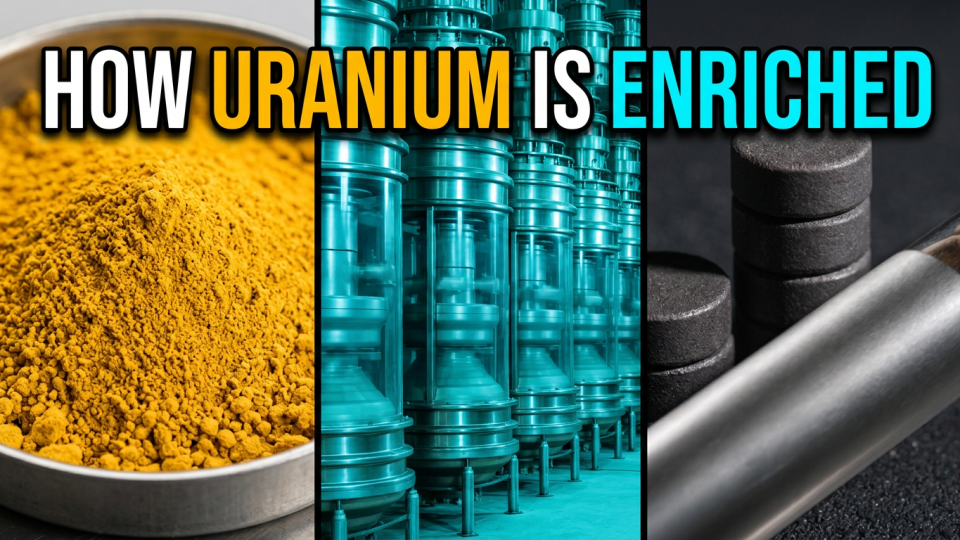
Mining and yellowcake: Uranium is mined in open pits, underground, or by in-situ leaching — pumping acidic solution through porous rock to dissolve uranium and pump it back to the surface. The ore contains only 0.1 to 0.5 percent uranium by weight, meaning hundreds of tonnes of rock must be processed per tonne of uranium. At a uranium mill, the crushed ore is leached with sulfuric acid, the dissolved uranium is purified by solvent extraction, and precipitated as yellowcake — uranium oxide U₃O₈ — a dense yellow powder containing 60 to 80 percent uranium. This is the form in which uranium is commercially traded from mine to conversion plant.
Conversion to UF₆: Centrifuge enrichment plants cannot process solid powder. The uranium must first be converted to uranium hexafluoride — UF₆ — the only uranium compound that is a gas at reasonable temperatures. At a conversion facility, yellowcake is reacted with hydrogen and then fluorine gas to produce pure UF₆ — a colorless solid at room temperature that sublimes to gas at just 56°C. UF₆ is extraordinarily hazardous: it reacts violently with atmospheric moisture, instantly producing hydrofluoric acid (HF) — a compound that corrodes glass and metal, penetrates skin causing deep chemical burns, and is acutely toxic. Every UF₆ transport cylinder must maintain airtight integrity under all conditions. A release into humid air creates a dense toxic plume within seconds.
Gas centrifuge enrichment: UF₆ cylinders are heated at the enrichment plant, and the gas is fed into cascades of gas centrifuges — hollow vertical rotors spinning at tens of thousands of revolutions per minute inside evacuated casings. The peripheral speed of the rotor exceeds 500 meters per second — supersonic, faster than most rifle bullets — generating centrifugal force of approximately one million times gravity at the rotor wall. Because U-238 molecules (238 atomic mass units) are heavier than U-235 molecules (235 atomic mass units) by just 1.3 percent, the heavier molecules migrate slightly toward the wall while the lighter U-235 molecules concentrate slightly toward the centre. Each centrifuge stage enriches U-235 by only a tiny fraction — so the gas must pass through hundreds of centrifuges in series, a cascade, before reaching 3 to 5 percent. A typical 1,000 MW light-water reactor requires approximately 100,000 separative work units (SWU) of enrichment per year. Modern gas centrifuges consume only 50 to 100 kWh per SWU — versus 2,300 to 3,000 kWh per SWU for the older gaseous diffusion process. Global enrichment capacity in 2025 stood at approximately 68.1 million SWU per year.
Enrichment thresholds and the dual-use dilemma: Low-enriched uranium (LEU) is less than 20% U-235 — commercial reactor fuel sits at 3–5%, while HALEU for advanced reactors reaches 5–20%. Highly enriched uranium (HEU) is 20% or above. Weapons-grade uranium is 90% or higher — the Hiroshima bomb used approximately 64 kg at about 80% enrichment. Going from reactor grade to weapons grade requires approximately 200 SWU per kilogram versus 4 SWU for reactor fuel. But the cascade is the same technology. This dual-use reality means every enrichment facility on Earth operates under IAEA safeguards — continuous surveillance cameras, tamper-evident seals, and material accountancy tracking every gram. In 2026, Urenco USA — America’s only commercial enricher — completed 75 percent of its current expansion at Eunice, New Mexico, adding six new centrifuge cascades producing over 500,000 SWU annually, and broke ground on a new 2.1 million SWU plant with first production targeted for 2032.
Fuel fabrication: After enrichment, UF₆ is reconverted to uranium dioxide (UO₂) — reacted with steam, then reduced with hydrogen. UO₂ is a dark brown ceramic powder with a melting point of 2,865°C (versus steel at 1,370°C) that holds fission products within its crystal structure. The powder is pressed under high pressure into small cylindrical pellets approximately 1 cm in diameter and 1 cm tall, then sintered at approximately 1,700°C to achieve full ceramic density. Each pellet contains approximately 7 grams of uranium and releases energy equivalent to roughly one tonne of coal. Hundreds of pellets are stacked inside zircaloy fuel rods — thin-walled tubes of zirconium alloy, chosen because zirconium is nearly transparent to neutrons. Each rod is approximately 4 meters long. Hundreds of rods are assembled into a fuel assembly, the unit loaded directly into the reactor core.
0.7% in the ground. 4% in the reactor. Hundreds of centrifuges spinning at 500 m/s. One of the most complex and intensely monitored industrial journeys on Earth.
