Paper Title: Assessment of somatic excitability and dendritic responses in a reduced conductance-based CA1 neuron model
Author: Youwang Yao
Corresponding Author: Youwang Yao (youwang.yao@duke.edu)/USA
Abstract
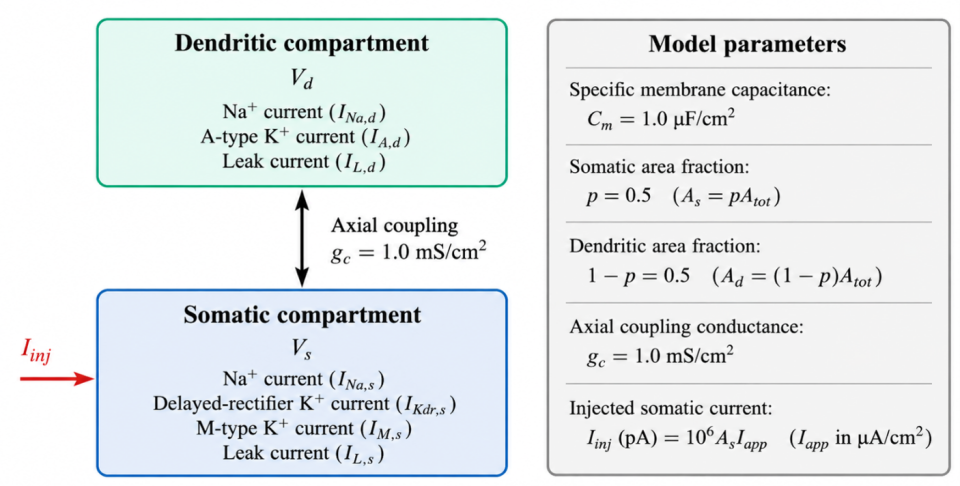
A reduced conductance-based model was assessed through somatic excitability, firing dynamics, and dendritic conductance responses. The reported baseline spike had a threshold of −36.5 mV, a baseline-to-peak amplitude of 115.1 mV, and a half-width of 0.93 ms. At 8 µA/cm², ISIs shortened before lengthening by 17.8% relative to the minimum interval. Dendritic A-current blockade increased amplitude from 92.8 to 100.8 mV, and halving dendritic Na⁺ conductance reduced it to 69.9 mV. Two new numerical experiments used a complete reference implementation with published channel kinetics. Joint waveform retuning reduced the normalized feature error by 84.7%, shifting the threshold from -39.13 to -49.36 mV and the amplitude from 114.71 to 96.76 mV. Matched zero-M and increased-M controls linked M-gate availability to late ISI lengthening, while a fixed A-inactivation gate changed the early-interval trajectory. The reported and reference baselines use their respective specified kinetics. These analyses quantify waveform trade-offs and conductance-dependent firing in the compact representation.
