Paper Title: Performance comparison of ML algorithms for liver disease prediction
Authors: Abid Hussain, Anjna Sharma
Corresponding Author: Abid Hussain (abid.hussain@cpur.edu.in)/India
Abstract
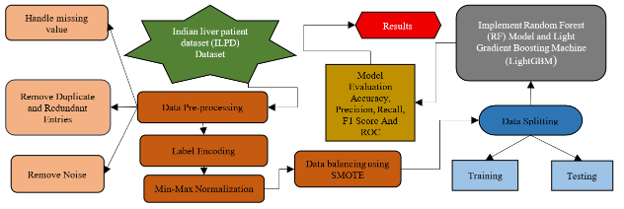
Liver disease is a leading cause of mortality throughout the world. Numerous lives may be saved if it can be detected in its early stages. Therefore, early detection of liver disease is crucial. This study aims to find a reliable ML model that can predict liver disease development using demographic and clinical data. This research explores several ML methods and introduces the most promising ones, Random Forest (RF) and Light Gradient Boosting Machine (LightGBM), for classification. The Indian Liver Patient Dataset (ILPD) is preprocessed by encoding categorical data, imputing missing values, removing duplicates and noise, applying Min-Max scaling, and balancing the data with SMOTE; this yields a dataset of 583 cases with 11 clinical and demographic characteristics. Models are assessed using F1-score, recall, accuracy, and precision, with an 80:20 stratified train-test split. While the proposed LightGBM model achieves a 99.8% ACC rate, a 99.9% PRE rate, a 99.5% REC rate, and a 99.8% F1-score (F1), the experimental results show that the RF model achieves a 99.6% PRE rate, a 99.7% REC rate, and a 99.6% F1-score (F1). The findings confirm that the proposed models achieved high ACC and reliability in predicting liver disease, with LightGBM delivering the highest ACC and PRE.
