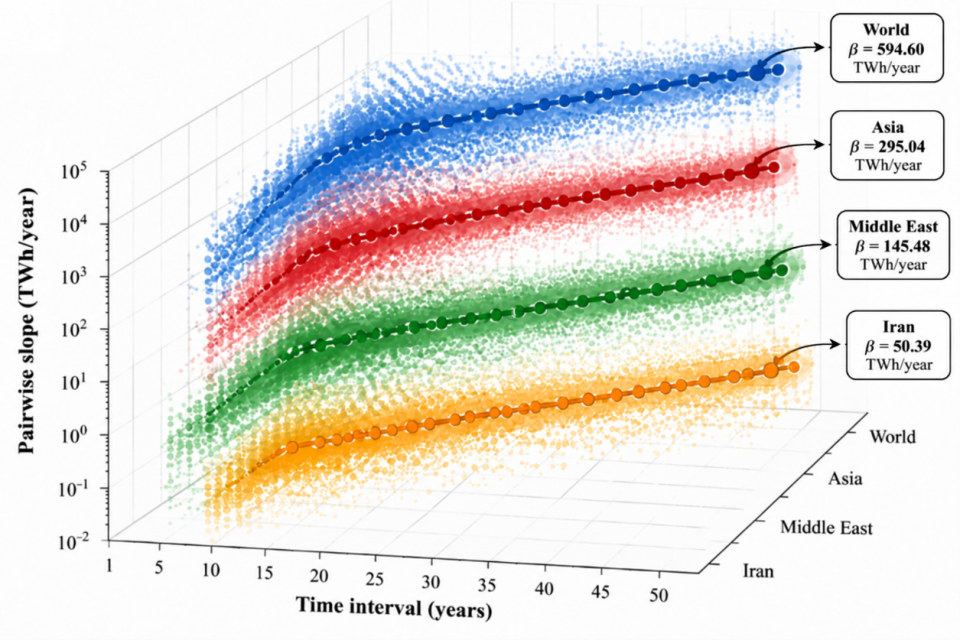
Paper Title: Long-term dynamics and future trajectories of natural gas production: a global, regional, and Iranian assessment
Authors: Afshin Gholamalipour, Mohammadali Allahrabbi Shirazi, Hossein Yousefi
Corresponding Author: Hossein Yousefi (hosseinyousefi@ut.ac.ir)/Iran
Abstract
Natural gas plays an important role in sustainable energy supply and future planning. This study examines trends in global natural gas production, Asia, the Middle East, and Iran, and outlines its outlook using several analytical methods. Annual data for the period 1970-2025 were examined using trend analysis and time series forecasting methods. The significance of trends was determined using the Mann–Kendall test, and the rate of change was determined using Sen’s slope estimator. Then, an ARIMA model was developed to forecast production up to 2035, and its accuracy was evaluated using RMSE, MAE, and MAPE criteria. The results showed that production increased in all four ranges and was statistically significant (p < 0.001). The Z-statistic values were between 9.69 and 10.83. Sen’s slope estimates showed annual increases in production in the world, Asia, the Middle East, and Iran of 594.60, 295.04, 145.48, and 50.39 TWh/year, respectively. The ARIMA forecast also indicated that this increase would continue until 2035. Global production would increase from 41,964.71 TWh in 2025 to about 48,159.54 TWh. Production in Asia, the Middle East, and Iran in 2035 was also predicted to be about 18,096.72, 9,348.25, and 3,305.26 TWh, respectively. MAPE values below 10% indicate the model’s accuracy in representing historical production behavior. By examining trend significance, estimating growth rates, and forecasting, we can better understand long-term changes in natural gas production.
