Paper Title: The application of artificial intelligence in large-scale high-end equipment manufacturing projects: the moderating effect on the relationship between corporate culture, advertising investment, and strategic management of Shandong SMEs
Authors: Hui Yan, Rozaini Binti Rosli
Corresponding Author: Rozaini Binti Rosli (rozaini@lincoln.edu.my)/ Malaysia
Abstract
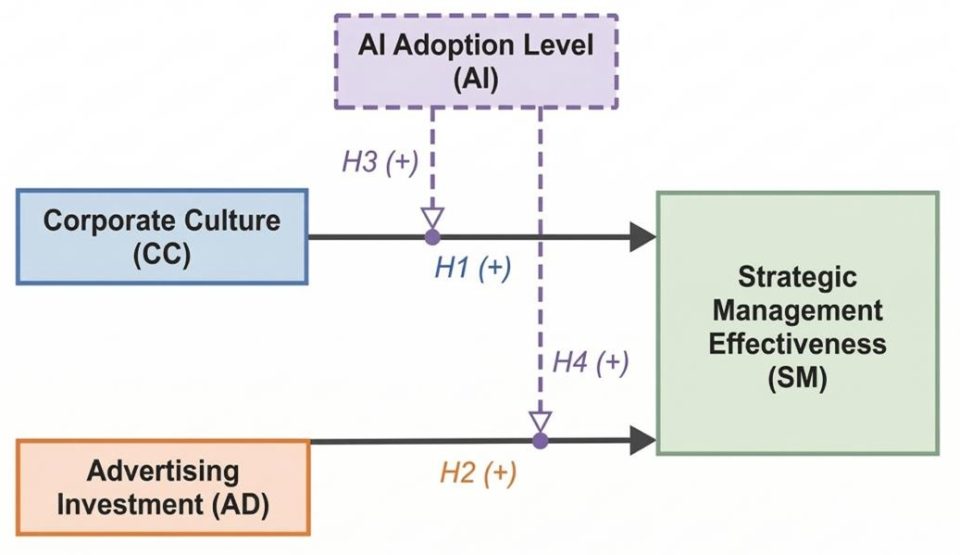
In view of the rapid development and penetration of artificial intelligence (AI) into the field of manufacturing, the strategic management of small and medium-sized enterprises (SMEs) in large-scale high-end equipment projects is undergoing a new transformation, yet previous studies have not taken artificial intelligence adoption as a boundary condition to examine the influence of corporate culture and advertising investment on strategic management effectiveness. Based on the Resource-Based View (RBV) and Contingency Theory, this study proposes a moderation model and tests it empirically. Questionnaires were distributed to 323 SME managers in Shandong Province, and hierarchical regression analysis and 5,000-resample bootstrapping were used to test the proposed model. The results show that all four hypotheses proposed in this study were verified. Corporate culture and advertising investment positively influence the effectiveness of strategic management. Artificial intelligence adoption plays a significant role in moderating these two relationships, and corporate culture is more important than advertising investment in this regard, since the interaction effect of corporate culture and artificial intelligence adoption on strategic management effectiveness is greater than that of advertising investment and artificial intelligence adoption. Under high levels of artificial intelligence adoption, the slope coefficient of corporate culture on strategic management effectiveness is 2.8 times that of low levels of artificial intelligence adoption. The study provides a new framework for strategic artificial intelligence management that integrates the RBV and Contingency Theory.
