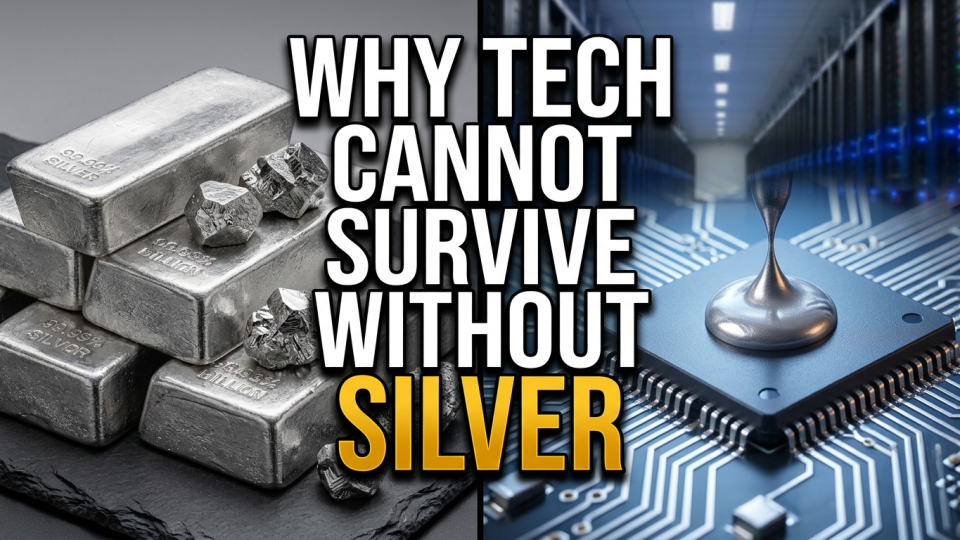
Why Modern Technology Cannot Survive Without Silver
Right now, silver is inside your smartphone. It is inside every solar panel on Earth. It is inside the circuit boards of every electric vehicle, data center, and 5G tower built this year. Silver has the highest electrical conductivity, the highest thermal conductivity, and the highest reflectivity of any metal on Earth. And the world is running out.
For six consecutive years, global silver demand has exceeded supply. Industrial applications consumed a record 680 million ounces in 2024 — 61 percent of all silver used worldwide. And most people have never thought about where it comes from or how it gets made.
The complete story, from ore to technology:
Where silver actually comes from: Most people assume silver is mined from silver mines. The reality is that approximately 70 to 74 percent of all silver mined globally is a byproduct — recovered from copper, lead, zinc, and gold deposits where silver occurs in trace quantities. Mexico, China, Peru, Russia, and Chile are the largest producers, many of them primarily base metal miners. Silver concentrations in typical ore bodies range from just 30 to 300 grams per tonne. High-grade primary silver veins can reach 1,000 grams per tonne — but these are rare and increasingly depleted. The critical supply implication: silver production cannot simply respond to rising prices, because it is tied to base metal mining economics.
The three properties that make silver irreplaceable: Silver simultaneously holds three absolute records among all metals. Electrical conductivity: 63 million siemens per meter, the highest of any metal, 6 percent better than copper. Thermal conductivity: highest of any metal. Optical reflectivity: over 95 percent of visible light reflected, highest of any metal. The reason for the electrical superiority lies in silver’s atomic structure: a single highly mobile valence electron in a crystal lattice that allows minimal electron scattering, meaning less energy is lost as heat when current flows. No other affordable metal combines all three properties.
Mining, crushing and froth flotation: Once silver-bearing ore is extracted, it is crushed and ground in ball mills to below 75 micrometers in particle size, liberating silver sulfide minerals from host rock. The slurry enters froth flotation cells where chemical collectors selectively coat silver-bearing particles, making them hydrophobic. Air is bubbled through the slurry, lifting these particles as a mineral-rich froth. The gangue rock sinks. The concentrated sulfide product, containing silver, copper, lead, and zinc, is skimmed and thickened for the next stage.
Smelting and the Doré bar: For concentrates, pyrometallurgical smelting in high-temperature furnaces produces a Doré bar, a crude silver-gold alloy typically 90 to 95 percent precious metal combined. The bar also contains gold, copper, iron, lead, bismuth, and numerous trace elements that must all be removed before the silver can be used in electronics or solar cells.
Moebius electrolytic refining to 99.99%: The Doré bar is cast into anodes and immersed in a silver nitrate electrolyte in a Moebius electrolytic cell. Electrical current dissolves the crude anode — silver ions migrate through the electrolyte and deposit as pure crystalline silver on the cathode. Gold and platinum group metals fall as anode slime at the bottom. Base metals remain in solution. The harvested silver crystals, melted and cast, assay at 99.99 percent, four nines, meeting the London Bullion Market Association good delivery standard. At this purity, any impurity would measurably reduce conductivity.
Solar photovoltaics — the largest single consumer: In 2024, solar panels consumed approximately 197 million ounces of silver — nearly 20 percent of total global demand. Silicon solar cells require silver paste — ultrafine silver particles mixed with glass frit — screen-printed as microscopic conductive finger electrodes across the cell surface. Silver’s unmatched conductivity ensures maximum electron collection with minimum resistive loss. Modern TOPCon cells require approximately 13 milligrams of silver per watt. Next-generation heterojunction HJT cells require approximately 22 milligrams per watt — 50 percent more — because they apply silver paste to both sides of the cell to achieve higher efficiency. No substitute material matches silver’s combination of conductivity and process compatibility with silicon.
Electrical contacts — 150 to 180 million ounces per year: Wherever an electrical circuit must be physically opened and closed — every relay, circuit breaker, power contactor, and automotive switch — silver is preferred. Silver forms a stable, low-resistance contact surface that resists oxidation better than copper, ensuring reliable switching over millions of cycles. The global electrical contacts market consumes approximately 150 to 180 million ounces annually.
Electric vehicles — 20 percent demand surge in 2025: A battery EV contains approximately 25 to 50 grams of silver across its power inverter, battery management system, charging contacts, and sensor electronics. Global EV deliveries reached 17.6 million vehicles in 2024. EV-related silver demand jumped 20 percent in 2025 alone — and the trajectory continues upward as EV penetration rises globally.
Data centers and AI infrastructure: Server boards, GPU interconnects, and high-speed memory modules require silver-based thermal interface materials and silver-containing solder for reliability under high thermal loads. The global data center market added over 80 gigawatts of new capacity in 2025. Each server rack contains silver in hundreds of individual components.
Biomedical and optical applications: Silver ions are broadly antimicrobial — disrupting bacterial cell membranes and preventing biofilm formation. Silver nanoparticle coatings are applied to medical implants, wound dressings, catheters, and hospital surfaces. Silver-coated optical mirrors in telescopes, laser systems, and solar concentrators exploit its 95 percent reflectivity — the highest of any metal for broadband visible and infrared applications.
The supply deficit, six consecutive years: The global silver market recorded a supply deficit in 2026 for the sixth consecutive year, with total demand of approximately 1.1 billion ounces against supply of 1.07 billion ounces. Mine production in 2025 reached approximately 847 million ounces — flat versus a decade ago despite rising prices, because 70 to 74 percent of silver production is locked to base metal mining economics that do not respond to silver price signals. The structural deficit is being drawn down from above-ground stocks — a situation that cannot continue indefinitely.
Three world records. Six consecutive supply deficits. The metal inside every solar panel, every EV, every smartphone, and every data center on Earth.
