Paper Title: Effect of Ni-additive on jute stick charcoal-mediated carbon anode of Li-ion batteries
Authors: Tauhidul Hossain, Md. Arafat Rahman, Konok Chandra Bhowmik, Rudra Barua
Corresponding Author: Md. Arafat Rahman (arafat@cuet.ac.bd)/ Bangladesh
Abstract
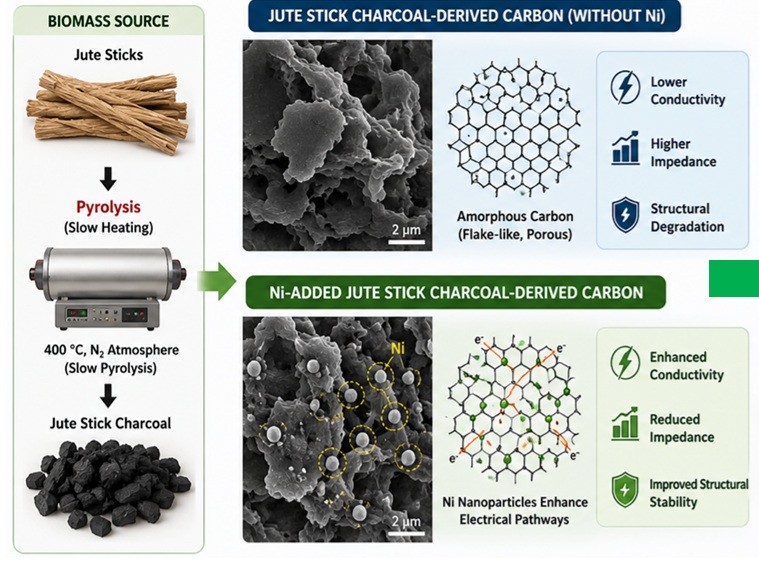
Li-ion batteries (LIBs) have gained popularity as a potential device for sustainable energy transition. Because of its simple and environmentally benign production, biomass-derived amorphous carbon is a viable anode for LIBs as a possible replacement for graphite. However, its performance is limited by structural deterioration and low conductivity. Therefore, developing low-cost biomass-derived carbon anodes with improved electrical conductivity and cycling stability is important for sustainable LIB applications. Here, slow pyrolysis has been used to produce amorphous carbon from jute stick charcoal. The jute sticks were pyrolyzed at 400 °C, and the structural characterization confirmed the successful formation of amorphous carbon with flake-like porous morphology. The resulting carbon was evaluated as an anode material in a full cell. After 500 cycles, this anode demonstrated a discharge capacity of 125.46 mAh/g and a Coulombic efficiency (CE) of 68.4% at 1C. In addition, Ni metal powder additives were added to improve cell performance. Ni considerably reduced the cell impedance and enhanced electrode conductivity. As a result, after 500 cycles, the Ni-added anode demonstrated improved performance with a discharge capacity of 148.02 mAh/g and a CE of 73% at 1C. Electrochemical investigations further indicated reduced cell resistance after Ni incorporation, demonstrating enhanced electronic conduction and interfacial charge-transfer kinetics.
